Running a franchise means keeping dozens (or even hundreds!) of locations on the same page. But when marketing files are scattered across emails, old folders, and random shared drives, things fall apart fast. Off-brand visuals pop up at local stores, campaign rollouts slow to a crawl, and your team wastes hours hunting for the right logo or template instead of actually reaching customers.
The answer? Creative and media asset management. In this blog, Olivia Reck, Account Specialist, will explain how the solution to your problem is to give every franchise location one clear, organized place to find, use, and share approved marketing materials.
What You’ll Learn:
- What Is Creative Asset Management (CAM)?
- Creative Asset Management vs. Digital & Media Asset Management
- Why Creative & Media Asset Management Matters for Franchisees
- Key Features to Look for in Franchise-Friendly Asset Management
- Best Practices For Setting Up A Brand Asset Management System
- How Rallio Helps Franchisees Manage Creative & Media Assets
- FAQs
Expert Opinion on Media Asset Management
As your business scales and you add locations, media asset management is no longer optional. With so many locations and so many moving parts, the need for a single source of truth becomes critical. Without it, franchise teams end up creating their own materials, which often stray from brand guidelines and dilute the identity you’ve worked so hard to build.
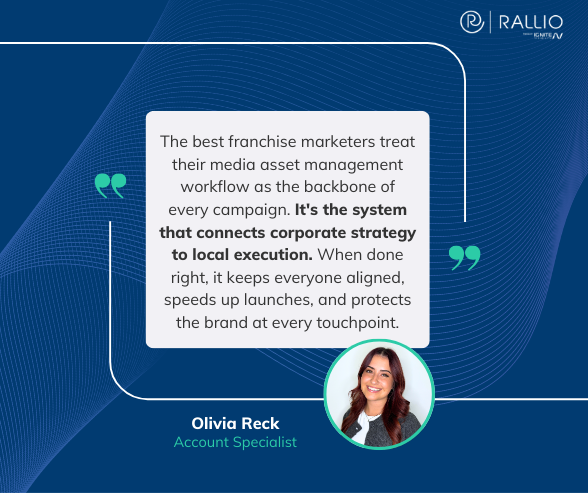
The best franchise marketers treat their media asset management workflow as the backbone of every campaign. It’s the system that connects corporate strategy to local execution. When done right, it keeps everyone aligned, speeds up launches, and protects the brand at every touchpoint.
Think of it this way: if your marketing is a machine, media asset management is the engine that keeps it running smoothly.
What Is Creative Asset Management (CAM)?
Creative asset management (CAM) is the process of organizing, storing, and sharing all the creative materials your brand uses for marketing. In simple terms, it’s a system that keeps all the files your team needs in one easy-to-find place.
The types of assets managed in a CAM system include:
- Logos
- Brand kits
- Photos
- Videos
- Social media graphics
- Design templates
- Full campaign files
Basically, if it’s something your marketing team creates or uses to promote the business, it belongs in your creative asset management software.
Digital asset management isn’t just about storage. It will provide support throughout the content lifecycle. It covers everything from the moment an asset is created through the review and approval process to distribution across locations. This means your corporate team can design a social media template, get it approved, and push it out to every franchisee – all within the same system and without a single email attachment.
Creative Asset Management vs. Digital & Media Asset Management
You’ve probably seen a few similar terms floating around: digital asset management, media asset management, and creative asset management. While they overlap, each one serves a slightly different purpose. Understanding the difference helps you pick the right tools for your franchise.
- Digital asset management (DAM) is all about centralized storage. Think of it as the brand vault. Logos, fonts, images, and brand guidelines are stored here so anyone on the team can access them without having to guess which version is the latest.
- Media asset management (MAM) is designed to handle larger, more complex files such as video and audio. If your franchise produces commercials, podcast ads, or social media video content, a MAM system helps manage workflows from editing to final export.
- Creative asset management (CAM) ties it all together. It bridges creation, collaboration, approvals, and distribution into one connected process.
When you combine the strengths of all three through the right digital asset management tools, your franchise marketing becomes faster, cleaner, and far more consistent.
Why Creative & Media Asset Management Matters for Franchisees
For franchise businesses, creative and media asset management directly impacts how well your brand shows up in every market you serve. Here’s why it matters so much:
Brand Consistency at Scale
Every franchise location represents your brand. When a store uses an outdated logo or the wrong color palette, it chips away at the trust you’ve built. A strong asset management system ensures every location uses approved visuals, messaging, and templates – no exceptions.
A centralized system allows local teams to retain their voice while still operating within clear brand guardrails. The result is a brand that looks and feels the same whether a customer visits a location in Texas or Vermont.
Faster Campaign Execution
Without a central system, launching a campaign across multiple locations is painfully slow. Franchisees dig through emails, search outdated folders, and send endless messages asking for the “right” file. All of that wasted time delays the campaign and hurts results.
With the right creative asset management software, franchisees can quickly find, customize, and publish assets as soon as a campaign goes live. No more bottlenecks. No more waiting on corporate to resend a file. Everything is in the right place and ready to go.
Better Local Marketing Performance
One of the biggest advantages of a good media asset management workflow is that it balances control and flexibility. Corporate teams maintain oversight of brand standards, while franchisees gain the freedom to tailor campaigns for their local audience.
This makes it much easier to localize national campaigns for regional relevance. A franchisee in Miami can adjust messaging for their market without going off-brand, while a location in Chicago does the same for theirs. The result is marketing that feels personal and local but still clearly belongs to the same brand family.
Less Rework, Less Waste
How many hours does your team spend fixing mistakes that could have been avoided? Duplicate files, wrong versions, and unapproved edits create a cycle of rework that drains time and money from both corporate and franchise teams.
Clear version control and built-in approval processes prevent these headaches. Everyone knows which asset is current, who approved it, and where to find it. Following best practices for setting up a brand asset management system results in fewer errors, less duplication, and a more efficient workflow for everyone involved.
Key Features to Look for in Franchise-Friendly Asset Management
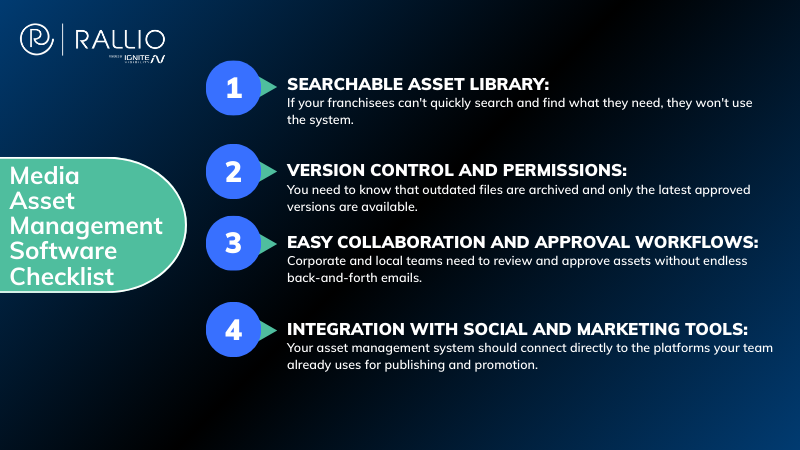
Not every asset management tool is built for the unique needs of franchise systems. When evaluating the best media asset management software for your brand, use this checklist to guide your decision:
Best Practices For Setting Up A Brand Asset Management System
Setting up a media asset management system isn’t super complicated, but it does require a little planning. Here are some tips to improve your creative asset management software implementation:
- Audit your existing assets: Go through everything your brand currently uses and remove anything outdated, off-brand, or duplicated.
- Define your brand rules once and enforce them centrally: Your guidelines for logos, colors, fonts, messaging, and templates should be centralized in one place and serve as the single standard everyone follows.
- Provide hands-on training for your franchisees: Even the best digital asset management tools are useless if local teams don’t know how to find and use the assets inside them.
- Measure success: KPIs such as campaign launch speed, brand consistency, and local engagement metrics will indicate whether the system is working.
The biggest tip: Don’t wait until it’s too late to implement your new system. The best time to set up your asset management system is before you scale, not after. If you’re already managing multiple locations, the second-best time is right now.
How Rallio Helps Franchisees Manage Creative & Media Assets
Rallio was built with franchise systems in mind, making it one of the best media asset management software options for multi-location brands. Here’s how it works.
- Centralized Media Assets: No more guessing which file is current or chasing down media assets from corporate. Everything lives in a single, organized library that’s always up to date.
- Built for Multi-Location Marketing: Corporate teams control brand standards while franchisees execute locally. This balance ensures your brand remains consistent across all locations while local teams have the tools they need to market effectively in their communities.
- Seamless Content Creation and Distribution: Assets flow directly into social publishing without extra steps or downloads. Franchisees can go from finding an asset to posting it on social media in minutes.
- New Rallio + Canva Integration: Franchisees can import brand-approved Canva designs directly into Rallio and export Rallio media to Canva for quick edits. Corporate teams maintain design control while empowering local teams to move faster.
From content creation to scheduling and posting, Rallio keeps creative workflows, asset management, and social execution connected. Instead of juggling five different tools, franchise teams get everything they need on a single platform designed for how they actually work.
FAQs About Digital Asset Management Tools
1. What is media management in marketing?
Media management in marketing is the process of organizing, storing, and distributing all the media files a brand uses for its campaigns. This includes images, videos, graphics, and other creative materials.
2. How is media management different from just using cloud storage?
Cloud storage holds files, but it doesn’t organize them for marketing use. Media management systems add layers like searchability, version control, approval workflows, and direct integration with publishing tools. They’re purpose-built for marketing teams, not just general file storage.
3. Why is media management especially important for franchise businesses?
Franchise businesses operate across many locations, each with its own local marketing needs. Without a centralized system, it’s nearly impossible to keep every location on-brand. Digital asset management tools give franchise systems the control and consistency they need while still allowing local flexibility.
4. What types of assets should be included in a media management system?
A complete system should include logos, brand guidelines, photos, videos, social media graphics, design templates, campaign files, and any other materials used for marketing. The goal is to have everything a franchisee might need in one organized, easy-to-access place.
5. How does good media management improve marketing performance?
When assets are organized and easy to find, campaigns launch faster and with fewer errors. Franchisees spend less time searching for files and more time engaging customers. Consistent branding across all locations also builds stronger trust and recognition with your audience.
Streamline Your Social Media Management with Rallio
Are you looking for the best media asset management software for your franchise? You’ve found it in Rallio!
We’ve helped hundreds of franchises simplify their processes without limiting their creativity. Are you ready to see how we can help you? Schedule a free, no-strings-attached demo today!

Olivia Reck is an Account Specialist at Rallio, Powered by Ignite Visibility, where she supports the support team, account managers, and leadership to ensure clients receive top-tier service and results. Since joining Rallio in 2022, Olivia has developed a strong understanding of the company’s mission and a passion for helping brands grow. She holds a degree in Communications from California State University, Long Beach. She loves collaborating with others, learning new things about marketing and technology, and finding innovative ways to drive engagement and success.