


Multi-location SEO: the TL;DR
- Multi-location SEO means optimizing every location of a business to rank in its own local market: location pages, Google Business Profiles, citations, and reviews, multiplied across the network.
- The work itself is table stakes. What separates winning brands is measurement: a per-location scorecard tracking rank reality, profile pulse, page proof, and review trajectory.
- Tier your locations into winning, holding, and quietly losing. Fix your quietly-losing locations in high-value markets first. Leave winners alone.
- Keep all your locations on one domain, in subfolders. Put the ownership split in writing: corporate owns the system, each location owns its local truth.
- Judge your progress market by market, never by the brand average. The average is where losing locations hide.
Most multi-location SEO advice stops at the to-do list, and the advice itself is usually fine. What it never answers is the question that decides budgets: out of everywhere you operate, which locations are winning their market, and which are quietly invisible?
We wrote this guide for the people who answer for local search at scale. Franchise marketers, multi-unit operators, the one person responsible for 200 storefronts.
Maybe that’s you.
We’ll cover the essentials briefly, then spend most of our time on the part other guides skip. You’ll learn how to measure every location, find the ones quietly losing, and fix those first.
What is multi-location SEO?
Multi-location SEO (also called multi location local SEO) is the practice of optimizing each location of a business so it ranks in its own local search results. It covers the location pages, Google Business Profiles, citations, and reviews every location needs to be found by nearby customers.
Single-location local SEO is one market, one profile, one page. Multi-location SEO multiplies that work across 10, 50, or 500 markets.
It also adds two problems a single location never faces: keeping your brand consistent everywhere, and knowing which of your locations are pulling ahead or falling behind.
Which of your locations is actually winning at local search?
There’s an uncomfortable pattern in local search at scale. Teams can always report activity, what got shipped and where. Very few can prove which locations are winning their market and which are invisible in theirs.
Across the brands we support, visibility is rarely spread evenly. In our experience, a minority of locations earns most of the impressions while the rest sit unseen. That’s rarely because the work didn’t happen. It’s because nobody measured at the location level.
Can you name your three strongest markets right now?
Your three weakest?
That gap is what this section fixes.
Treat multi-location SEO as a portfolio you manage with data rather than a checklist you complete once.
Getting every location found in its own local market
Every location competes in its own market, against local rivals your headquarters has never heard of. A dental group’s Austin clinic competes with Austin dentists rather than with its own Dallas sibling.
So visibility has to be earned, and measured, market by market.
Brand-level averages are where losing locations hide: one strong number can conceal dozens of markets where you are nowhere, and the average will never tell you which ones.
The per-location scorecard: what to measure
Build one scorecard, one row per location, refreshed on a schedule. It lives wherever you already report, a spreadsheet or a BI tool, and pulls from your rank tracker, your profile insights, your site analytics, and your review data.
Four measures do most of the work:
- Rank reality. Where each of your locations actually shows for the searches that matter in its market, the Google Map Pack included.
- Profile pulse. Views, calls, direction requests, and clicks. Is this location’s profile earning attention or decaying?
- Page proof. Visits and conversions on that location’s own page, never the site total.
- Review trajectory. Volume, recency, and rating measured against local rivals instead of the brand average.
For outside proof: Google’s local ranking guidance names review count, ratings, and complete profile information among the factors that help local ranking.
One caution from experience.
Brand-level dashboards are built to reassure. Your scorecard’s job is the opposite.
It should make your weak markets impossible to miss.
While you’re at it, check how AI assistants describe each location; AI answers increasingly shape which locations get discovered, and auditing that footprint belongs on the same scorecard.
Winning, holding, quietly losing: tier your locations
With a scorecard in place, sort your locations into three tiers:
- Winning. In the map pack and top organic results, profile activity growing. Protect these and don’t tinker.
- Holding. Visible but not leading. Small fixes in content, reviews, and categories move these fastest.
- Quietly losing. Little visibility, stale profiles, thin pages. These need the full essentials pass below.
The tiers set your order of work. Fix your quietly-losing locations in high-value markets first. Harvest quick wins in holding markets. Leave winning markets alone.
This is triage.
The brands that win at 200 locations are usually the ones that stopped treating every location identically.
Regular monitoring and updates, market by market
A scorecard built once is just a snapshot. Review it monthly at minimum, weekly for your priority markets, and watch movement rather than raw position. A restaurant group can spot a location sliding out of the map pack weeks before revenue feels it.
Keep feeding each market, too.
When did each of your profiles last post something?
Stale hours, dead photos, and a profile that hasn’t posted in months all read as abandonment. The algorithm notices, and so does the customer deciding between you and the shop down the street.
Conduct competitor research in every market
Your real competitors are local, and they differ in every market. In one city you face a national chain. In another, a beloved independent with 900 reviews.
Audit the local winner in each priority market: who owns the map pack, which categories they claim, how fast their reviews compound. Then copy what works there, in that market. A brand-level competitor analysis can’t see any of this.
How long does local SEO take to show movement?
Expect months, not weeks.
Search engines extend trust slowly. A new page has to be crawled and understood. A profile has to build a track record. Reviews take time to accumulate.
Set your scorecard first.
Then judge your progress by movement per market rather than by a single go-live date.
The essentials every location needs
Measurement tells you where to act. These essentials are what you act on: the foundation work behind every local SEO strategy for multiple locations.
Local keyword research: targeting the right keywords in every market
Start from what people in each of your markets actually search. Core service terms stay constant. The modifiers change with geography: neighborhood names, “near me” phrasing, local landmarks.
Build one keyword set per service, then localize it per market against your own search data.
Don’t guess.
Optimized individual location pages
Each of your locations needs its own page. One URL per location, carrying what a searcher and a search engine both want. Name, address, phone, hours, the services offered at that location, directions, and a clear next step.
We cover the full recipe in our guide to location-specific landing pages. The short version: real information about the real location, never a template with the city swapped.
Location-specific content
Content is what separates a location page from a directory entry. A few paragraphs about the local team, local projects, and the questions people in that market actually ask are enough.
The content doesn’t need to be long, but it does need to be true and specific. That’s what keeps your two hundred location pages from reading as duplicates of each other.
Google Business Profile: claimed, complete, and active
Each of your locations needs its own verified Google Business Profile with accurate categories, hours, photos, and services. Complete beats clever: accurate, fully filled-out profiles are more likely to show up in local results than neglected ones.
At scale the challenge is operational. You’re keeping hundreds of profiles accurate through remodels, rebrands, and holiday hours. Assign someone to own updates now, because profile drift is what happens when nobody does.
Citation management: NAP consistency across directories
Citations are mentions of your name, address, and phone number across the web. Search engines cross-check them; customers navigate by them.
Keep your NAP identical everywhere, and get every location added on the directories that matter in your industry. That means the major map platforms plus the niche directories your customers actually use.
Fix inconsistencies before you build anything new.
Conflicting data undermines every other signal you send.
Gathering location-specific reviews and local reputation management
Reviews are ranking fuel and buying proof at once. Ask every customer, at every location, through a repeatable process. And respond, especially to the critical ones.
Never gate: filtering unhappy customers away from Google violates Google’s review policies, which explicitly prohibit discouraging negative reviews or selectively soliciting positive ones.
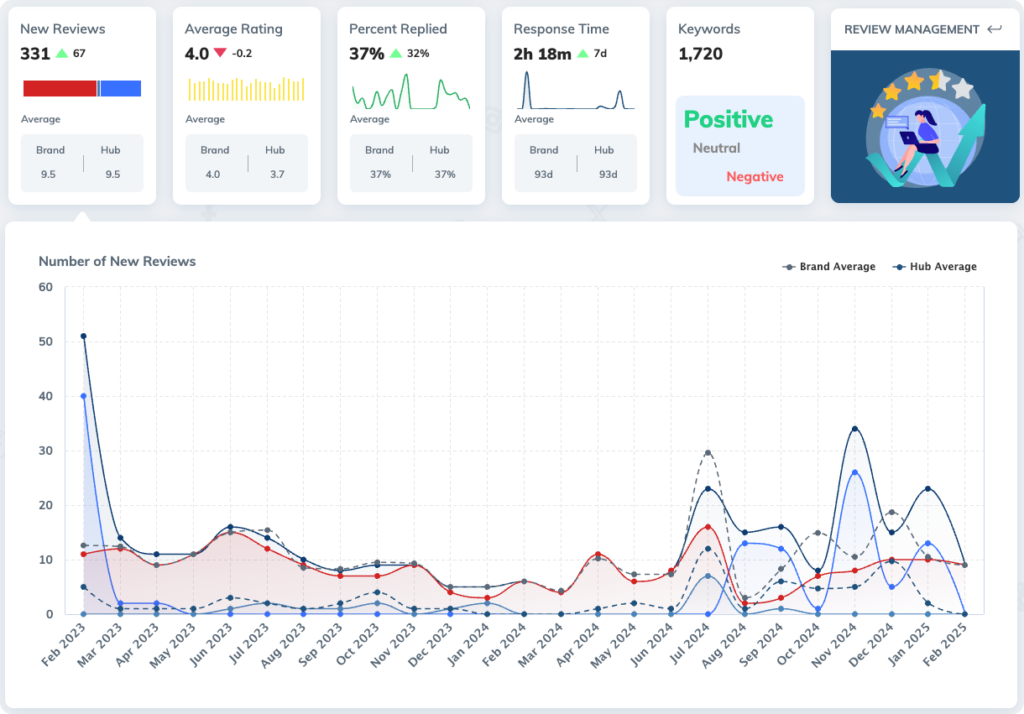
At scale, reputation management comes down to a repeatable workflow. Watch review velocity per location on your scorecard. A location that stops earning reviews usually has an operational problem rather than a marketing one.
Off-page SEO: prioritize link building with other local groups
Local links are the most under-used signal in multi-location SEO.
Sponsor the youth league, join the chamber, host the meetup. Each location earning a handful of genuinely local links builds authority no competitor can copy.
It’s slow work, but that’s also what makes it durable. A competitor can copy your page template in an afternoon.
They can’t join two hundred chambers of commerce by Friday.
Want this as a working document? Download the per-location audit checklist. It packs the essentials above into a location-by-location worksheet, plus the scorecard columns from the measurement framework. Run it on your ten most important markets first.
Site structure for multi-location SEO: one domain, organized well
One domain or many?
The structure question has a settled answer. Keep all of your locations on one domain, in organized subfolders (yourbrand.com/locations/austin).
Separate domains force each location network to earn authority from scratch, and in practice subdomains tend to behave like near-separate sites. Past roughly five to ten locations, subfolders win on every dimension that matters: consolidated authority, simpler management, cleaner reporting.
This holds for SEO for multiple cities and for dense single-city networks alike. Settle the structure once, then put your energy into the pages themselves.
URL organization and optimization
Keep URLs shallow, predictable, and human-readable: /locations/city, or /locations/city-neighborhood where markets overlap. A consistent pattern helps search engines understand the set, and lets you template pages, analytics, and audits.
Decide your pattern once, before page fifty exists.
Internal linking and your store locator
Link the network together deliberately. A store locator gives every location a crawlable front door. Regional hub pages help large networks. Every post about a market should link to that market’s page.
Internal links are how authority flows from your strong pages to your hundred quiet ones.
Make sure your website is mobile responsive
Most local searches happen on phones. If your location pages load slowly or render poorly on mobile, everything else on this page matters less.
Test yours on a real phone rather than a resized browser window, and fix whatever fails.
Who owns multi-location SEO: corporate or the location?
Multi-location SEO fails organizationally before it fails technically.
Corporate wants brand control. Locations know their market.
Hand either side everything and you lose.
Full central control produces templated pages no local customer recognizes. Full local control produces brand chaos and abandoned profiles.
So who should own what? The brands that win split the work deliberately and put it in writing. The same logic extends past search, too. Multi-location marketing execution across locations is its own discipline, and we cover it in its own guide.
The split that works: what corporate owns, what locations own
Corporate owns the system: site structure, page templates, the keyword framework, citation management, the scorecard, and the standards for photos and tone.
The location owns the local truth: hours, photos of the actual store, local content, review responses that sound like a human who was there, and community links.
Permissions should mirror the split. Locations get edit access to their profile’s local fields. Corporate holds the structural ones, like categories, names, and URLs.
Give every shared field a named owner.
In our experience, most “mystery edits” turn out to be two owners and no agreement.
Collaboration always wins
The split only holds with a working loop between the sides. Corporate shares each location’s scorecard. Locations flag what changed on the ground, like a remodel, a new competitor, or a local event worth posting.
The centralize-versus-delegate debate mostly misses the point. The answer is both, with clear lanes and a habit of actually using what the other side knows.
Where multi-location SEO breaks (and how to fix it)
These are the failure modes we see most often, roughly in order of damage.
Each is fixable, and far cheaper when you fix it early.
Inconsistent NAP data
The classic. A location moves, your website updates, and forty directories don’t.
Search engines lose confidence in your data. Customers drive to the old address.
The fix is one master record per location and a quarterly citation sweep against it.
Duplicate content issues across location pages
Fifty pages that differ only by city name teach search engines your pages are interchangeable, so few of them rank.
The fix is the location-specific content above.
If two of your pages could swap URLs and nobody would notice, neither deserves its ranking.
Poor site structure
Orphaned location pages, inconsistent URL patterns, locations scattered across subdomains.
Structural debt compounds with every new opening.
The fix is consolidating to one domain and one URL pattern, then redirecting the strays. Do it before your next twenty locations open.
Avoid keyword stuffing on location pages
Repeating “plumber in Austin” fourteen times doesn’t rank your Austin page.
It marks your page as template output.
Write for the person in that market. Let the service and the city appear where they naturally belong, in the heading and the opening paragraph.
Geo-targeting complexities: two locations, one city
Here’s the case almost nobody covers: multiple locations in the same city.
They share one market, so they can cannibalize each other, competing for the same map pack and splitting the same reviews and links.
Local SEO for multiple locations in one city only works when your locations are genuinely differentiated. Anchor each page to its own neighborhood. Tune categories to what each location actually does most. Route reviews to the location that served the customer.
One catch-all city page serving three storefronts helps none of them.
Service-area businesses without a storefront
Plumbers, cleaners, and installers serve areas rather than addresses, yet most multi-location SEO advice quietly assumes storefronts.
Three adjustments make it work.
Set service areas in each profile instead of a public address. Build pages for the areas you serve rather than the places you sit. And lean harder on reviews and local links, because proximity signals work differently without a storefront pin.
Expert Insight
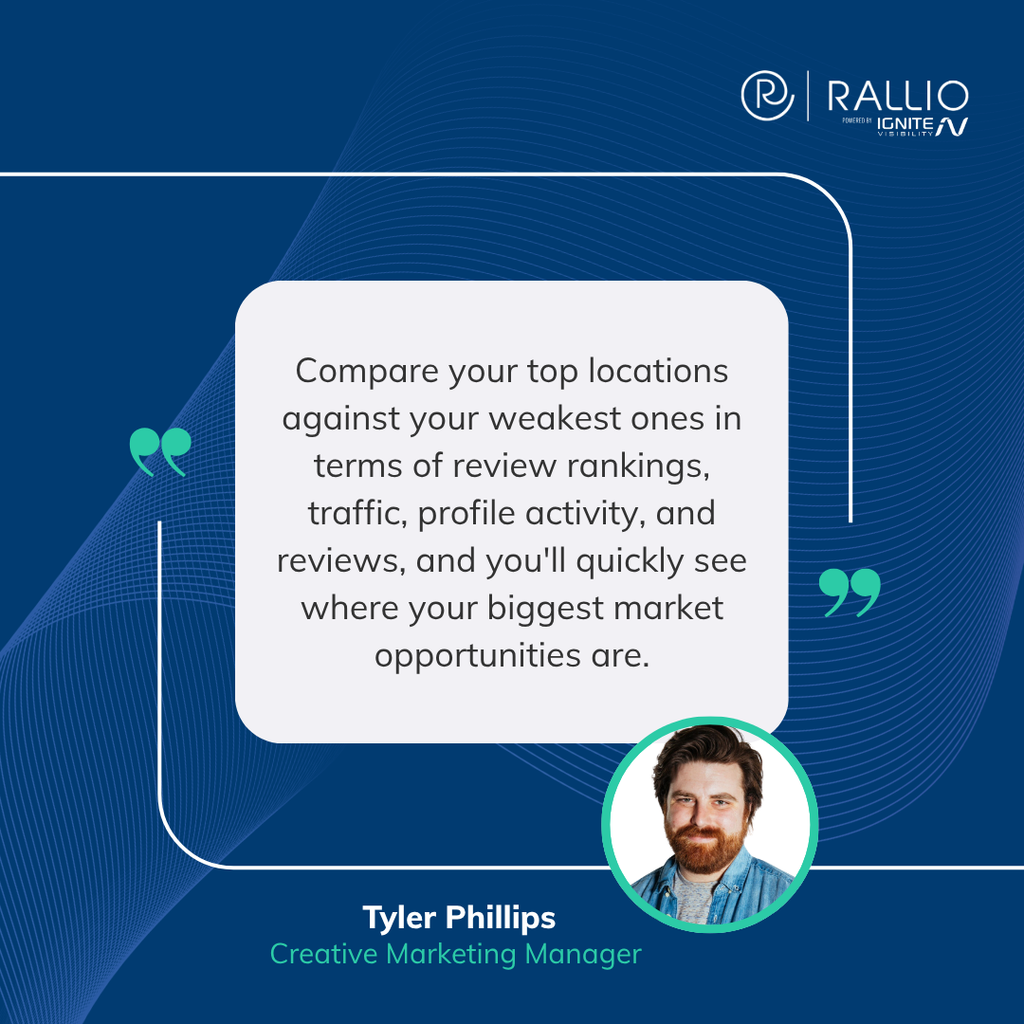
The multi-location brands that grow fastest are rarely the ones doing the most local SEO. They’re the ones that know exactly where their effort is going.
When you manage hundreds of locations, the temptation is to treat them identically: same checklist, same cadence, same budget. But every location lives in its own market, with its own competitors and its own gaps.
The moment a brand builds a per-location scorecard, the conversation changes. Instead of asking whether local SEO is working, they start asking which locations need help this month. That question has an answer you can act on.
My advice? Pick your ten most valuable markets and score them this week. Rank reality, profile activity, page traffic, review momentum. Don’t fix anything yet. Just look at the spread. The gap between your best and worst location is usually the biggest growth opportunity you already own.
Platform or agency: which do you need for multi-location SEO?
At some scale, spreadsheets and heroics stop working. The honest question isn’t whether you’ll need help.
It’s which kind.
An agency brings judgment and hands: strategy, content, cleanup projects. It fits when the problem is expertise, or when nobody internal owns local search at all.
A platform brings the system. Every profile, post, and review for every location lives in one place, so a small team can run hundreds of locations. It fits when the problem is scale. The work is known, and doing it 200 times is what breaks.
Many brands run both, with the platform as the operating system and an agency where the judgment lives. Our sister agency, Ignite Visibility, has a published case study that shows what the combination looks like at real scale. Orangetheory Fitness moved 1,500+ studio sites onto one centralized platform, kept schedules and promotions in franchisees’ hands, and grew organic traffic 25% year over year. It’s the same split this guide keeps coming back to: corporate owns the system, locations own their local truth.
Whichever route you choose, apply one test. Does it fit your industry, your services, your location count, and your markets? A partner that can’t answer at your scale will re-learn on your budget.
Rallio runs the execution half of this page: local social, reviews, and listings for every location, from one hub.
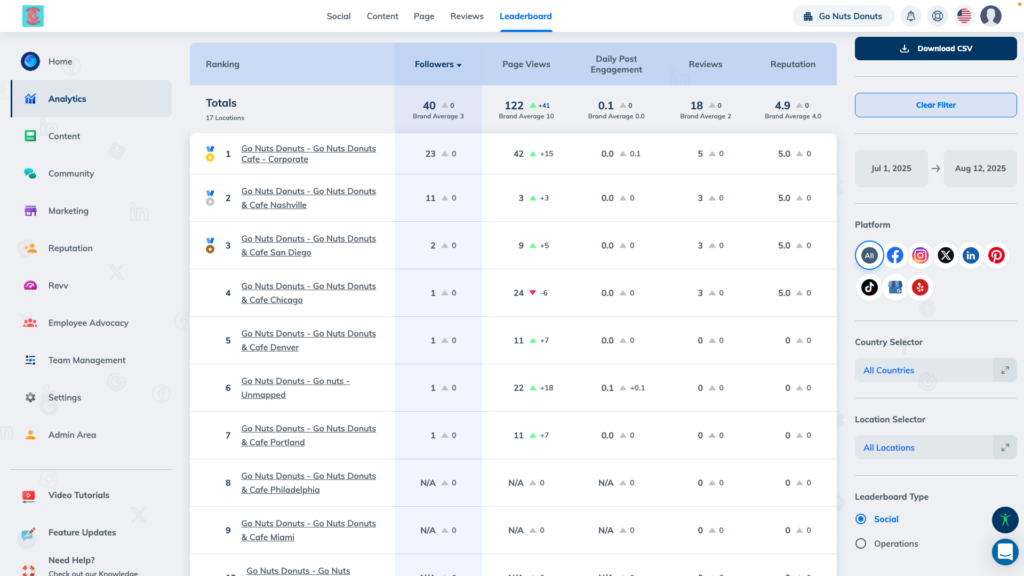
Its analytics track profile activity (views, calls, direction requests, website clicks) and review trajectory for the whole brand, a group of locations, or a single one, and a leaderboard ranks every location against the brand average. Add your rank tracker and site analytics, and the scorecard is complete.
Frequently asked questions (FAQs)
How do I track local SEO rankings for multiple locations?
Track each location separately, in its own market. Use a rank tracker that supports per-location keywords, pair it with each profile’s activity data and each page’s traffic, and put your results in one scorecard with a row per location. Judge every location against its local competitors, never against the brand average. That is the heart of local SEO for multiple locations: one system, judged market by market.
How long does local SEO take for multiple locations?
Local SEO for multiple locations typically shows movement in months, not weeks. Each market moves at its own pace, set by local competition and your starting point. Measure per location from a fixed start date. A single brand-level number hides the markets that are already responding.
Do I need a separate website for each location?
No. One domain with a subfolder per location outperforms separate websites for almost every business doing SEO for multiple locations. Separate domains divide your authority and multiply your maintenance. The exception is genuinely distinct brands under one company. Different names, services, and audiences can justify different sites.
How do I do local keyword research for multiple locations?
Build one core set of service keywords, then localize it for each market: city and neighborhood modifiers, local phrasing, and the terms your own search data shows for that area. The services stay constant. The geography changes. Refresh each market’s set when you review its scorecard rather than once at launch.
How does multi-location SEO work for a franchise?
The same signals apply. What changes is who does the work. The franchisor owns structure, templates, and standards. Franchisees own local content, reviews, and community presence inside those standards. Put that split in the brand guidelines, and give every franchisee the scorecard for their own market.
Ready to turn local presence into revenue?
Multi-location SEO is won by the brands that measure it. Start with the scorecard: pick your ten most important markets, run the audit checklist, and tier what you find.
Fix your quietly-losing locations first.
Then build the system that keeps every location accurate, active, and visible, without the heroic spreadsheet.
If you’d rather run that system than build it, that’s what Rallio is for: social, reviews, and listings for every location, run from one hub, with profile activity and reviews you can read for the whole brand, one location, or every location ranked side by side.
Book a demo and bring your hardest market.

Tyler Phillips is a Creative Marketing Manager at Rallio | Powered by Ignite Visibility, with over seven years of experience in SaaS and social media marketing and more than sixteen years in online video production. Known for his creative thinking and innovative problem-solving, Tyler specializes in designing and executing strategic digital advertising and content marketing campaigns. His passion lies in bridging creativity and data—turning complex ideas into simple, impactful brand narratives that connect, engage, and inspire.