


Your brand values lose meaning when your corporate office champions them, but each location experiences them differently. For example, you might say you value friendly, helpful service, but one team greets customers by name while another leaves reviews unread.
Brand values only become meaningful when customers actually experience them. For multi-location businesses, that means connecting the same core principles to local service, social content, and customer conversations.
In this blog, Tyler Phillips, Creative Marketing Manager, will explain what value driven marketing is and share brand values examples. He’ll also show you how to put it into practice and measure the results.
TL;DR:
- Lead with real values: Show customers what your brand stands for through actions, not slogans.
- Choose meaningful values: Focus on three to five principles your business can consistently demonstrate.
- Connect values to local actions: Give each location clear behaviors, messages, and proof to share.
- Create authentic content: Highlight real employee stories, customer experiences, and community involvement.
- Keep messaging consistent: Set corporate guidelines while allowing locations to reflect their local markets.
- Use AI responsibly: Draft content with verified details, and always have a person review it.
- Measure what matters: Track customer feedback, repeat purchases, referrals, and qualified inquiries by location.
- Make improvements: Use reviews and customer feedback to fix service gaps and strengthen trust.
What Is Value-Driven Marketing?
Value-driven marketing communicates your brand values through actions customers can see and experience. Three terms often get mixed up here: brand values, brand value, and value proposition. Let’s separate them first.
What Are Brand Values?
Brand values are the principles that guide your business decisions, employee standards, and customer service. Common examples include honesty, community, and quality.
True brand values go far beyond being slogans or taglines. They should show up almost everywhere, from how you handle a complaint to which suppliers you choose to how your team greets a customer.
For multi-location businesses, brand values keep every location pointed in the same direction. When two franchise owners in different states face a tough call, those shared values should help them resolve it similarly.
How Value Driven Marketing Puts Brand Values to Work
Value driven marketing communicates those principles through demonstrable actions. Instead of saying “we care about our community,” you show the youth team you sponsor, the local fundraiser you hosted, or the review you answered personally. Customers can check those things for themselves, and that’s what makes the messaging believable.
This approach puts your audience’s needs first. It shows how your products or services meet a real need, and then backs that up with behavior.
A value driven marketing strategy is the plan that ties it all together. It decides which values you lead with and how you put them into practice.
Think of it this way: traditional ads shout, “Look at us!” Value driven marketing takes a different approach. This type of marketing says, “We see you.” It also recognizes that transactions end at checkout, but relationships don’t. This approach prioritizes long-term loyalty over quick, one-time wins.
What is Brand Value in Marketing?
Brand value (singular) is something different. This term refers to your brand’s financial worth. Valuation firms estimate it using financial and market data. It can show up in things like reputation, recognition, and customer loyalty.
Brand value marketing focuses on growing that worth over time. Because trust and loyalty build financial value, living your brand values consistently plays a big role.
So, while the two ideas are connected, they aren’t the same. Brand values are what you stand for. Brand value is what the reputation is worth.
Brand Values vs. Brand Value vs. Value Proposition
A value proposition is the third piece. It explains why customers should choose a specific offer. It focuses more on brand values and is more practical than brand value.
|
Term |
What it Means |
The question it answers |
Example |
|
Brand Values |
Principles that guide decisions, employee behavior, and customer service |
What do we stand for? |
“Community first” |
|
Brand Value |
The financial worth of the brand as an asset |
What is our brand worth? |
A valuation of the brand as part of the company’s overall worth |
|
Value Proposition |
The reason customers should choose a specific offer |
Why should I choose you? |
“Same-day appointments at a location near you” |
In short, your brand values shape how you act, your value proposition shapes what you offer, and your brand value is part of the result. Value driven marketing connects all three, so customers hear the same message in your ads, social posts, and service at every location.
Value-Driven Marketing in Action
Here is a simple example. A product-first marketing approach for a household appliance company might say, “Our blender has 10 speeds!” That message is centered around the product.
On the other hand, value-driven marketing reframes the same blender in a concrete way that aligns with consumers’ and the brand’s values. Instead of focusing on the blender, the messaging would look more like: “Spend less time prepping meals and more time with family.”
The same idea works for a franchise gym. Instead of “state-of-the-art equipment,” a value driven message might be, “A place where every member is welcome at every location.” The local team then proves it with real posts, replies, and community-centered events.
An Expert Opinion on Value-Driven Marketing
What makes customers stick with brands like glue? It’s not flashy ads or discounts. It’s when companies live their brand values, like honesty, innovation, or community support.
It’s value-driven marketing, and it’s like making a promise and keeping it every single day. For example, a brand that shares real customer stories instead of polished ads builds trust. Or one that donates profits to causes customers care about. It’s good for the community and for the business. People reward brands that act with purpose.
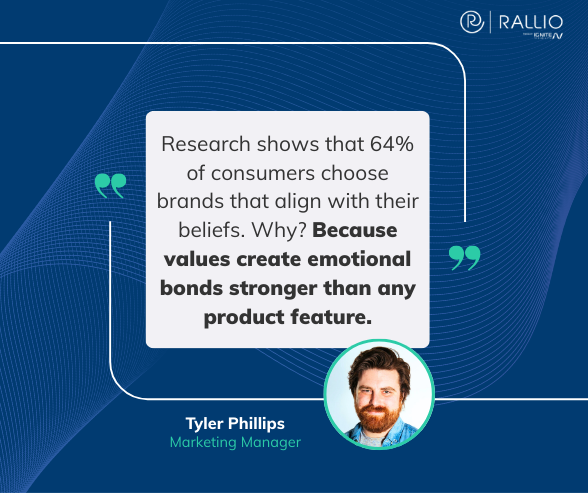
Research shows that 64% of consumers choose brands that align with their beliefs. Why? Because values create emotional bonds stronger than any product feature.
Think of Patagonia. Their commitment to the environment doesn’t stop at their tagline. It’s in every recycled jacket and climate campaign. That’s why fans proudly wear their logo. When brands walk their talk, customers become their loudest cheerleaders.
Why Brand Values Matter to Customers
Customers don’t choose brands for one reason. Price, quality, convenience, service, and values all play a part, but what matters most varies from person to person. You can’t outmarket a good product or a fair price, but your brand values will give customers more reasons to trust you and stay loyal.
What the Research Says About Beliefs and Buying
A recent study found that 64% of consumers across 15 countries say they buy, choose, or avoid brands based on their beliefs about what’s going on in society. While this shows that not every consumer buys because of brand values, most people look beyond the product when deciding which brand earns their business.
That same report found that trust carries about as much weight as cost and quality when deciding what to buy. When deciding whether to buy again, 70% of consumers are influenced by their previous experience with a brand’s products, service, website, or stores.
Other people’s opinions matter, too. In that same study, 59% said others influenced them, and 50% said the brand’s self-promotion influenced them.
For multi-location brands, that last point matters even more. Your corporate messaging can promise a lot, but if the local experience doesn’t match up, customers won’t trust you.
A Coffee Shop Example of Brand Values in Marketing
Let’s look at an example of how to include your values in marketing copy. Imagine two coffee shops:
- Shop A: “Best espresso in town!”
- Shop B: “Fair-trade beans that support farmer families.”
Shop B gives customers a reason that goes beyond the cup. When two shops seem equal on taste and price, that reason can tip the decision. But it only works if it’s true. If the sourcing doesn’t hold up or the barista can’t explain it, the message backfires.
Now picture 30 locations instead of one. Every shop needs to back up the claim. That means the same message in local social posts, the same answer at the counter, and the same story in a reply to a review. This is where brand values examples turn into daily habits rather than slogans.
Examples of Brand Values and What They Look Like in Practice
Brand values only work when people can see and experience them. Throwing the word “honesty” throughout your website doesn’t tell a customer much. A clear price on a service page does.
If you’re not sure where to start, these brand values examples show how a principle becomes a behavior and how to tie it into a piece of local marketing:
|
Brand Value |
What It Looks Like in Operations |
Local Marketing Example |
Evidence to Keep on Hand |
|
Honesty |
Prices are written down and customers are charged what they were quoted |
A location page and Google Business Profile listing with clear starting prices |
A published price list, receipts that match the quote, and few pricing complaints in reviews |
|
Reliability |
Teams update customers when an appointment time or business hour changes |
A text or social post that says, “We’re running 15 minutes behind. Thanks for your patience!” |
Appointment confirmation logs, on-time rates, and reviews that mention timeliness |
|
Community |
A location supports a local organization or group on an ongoing basis, not just once a year |
A post featuring a sponsored youth team, with photos and the team tagged |
A documented partnership and event photos |
|
Inclusion |
Service information is easy to access for customers with different abilities, languages, and needs |
A location page listing accessibility features, language support, and quiet hours, plus including alt text on all images |
Accessibility details verified at each location and customer feedback about how easy it was to find them |
Notice the pattern here. Each value starts with something the team does, and the marketing then shows it. The order matters. If you post about community involvement before a location has done anything, customers will notice that you aren’t being authentic.
This is also where a value based marketing strategy gets practice, because each value needs a behavior, a place to show it, and proof to back it up.
How Brand Values Connect to Customer Benefits
Brand values describe what you stand for. Customer benefits describe what people get. Because they’re linked, it helps to talk about both.
Let’s look at four common ways to frame these benefits:
- Functional benefits make life easier or more efficient. For example, a meal kit that saves time on a weeknight.
- Emotional benefits help customers feel confident or understood. These can build trust over time, but they don’t necessarily guarantee loyalty on their own.
- Economic benefits help customers save time or money. Clear pricing and honest comparisons are good ways to prove these benefits.
- Social benefits connect customers to something bigger than the purchase, like a local cause or a shared belief.
Most messages touch more than one of these benefits. For example, if a local clinic posts transparent pricing, that speaks to an economic benefit and supports honesty and trust.
Once you know which values and benefits you want to lead with, put them to work across every location.
The Business Impact of Leading With Value
Brands that prioritize value-driven strategies earn goodwill, while also dominating markets. Here’s why:
- Stronger Trust = Repeat Purchases: When brands consistently deliver on promises, customers stop shopping around. In fact, 87% of consumers pay more for brands they trust, even during inflation. That trust turns into repeat purchases.
- Deeper Engagement = Free Word-of-Mouth: Value-driven brands turn customers into megaphones. Millions share photos, effectively becoming unpaid ambassadors. This organic reach is priceless: 92% of consumers trust recommendations from people they know over ads.
- Sustainable Growth = Crisis-Proof Loyalty: When recessions hit, transactional brands crumble. Value-driven brands thrive because they’ve invested in building those longstanding relationships.
Real Examples of Brands Putting Values into Action
Brand values examples are easier to learn from when you can see the whole chain. A brand states a commitment, takes concrete action, and then markets it as something it actually did.
Let’s take a look at how value driven marketing works in practice, and what a multi-location brand can borrow from each one.
Patagonia: Worn Wear
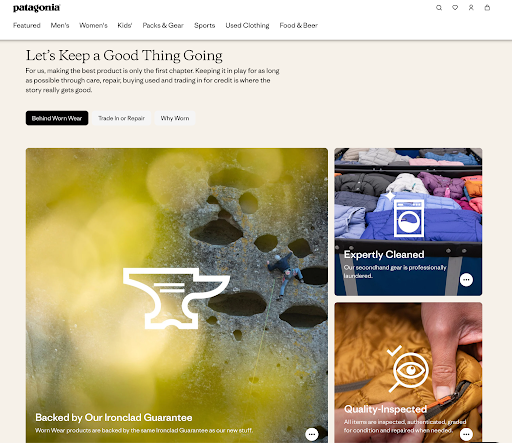
Stated commitment: Patagonia says its goal with Worn Wear is to “reduce our collective impact by changing the way we consume.”
Concrete action: Worn Wear lets customers trade in eligible Patagonia gear for credit and buy used gear that is backed by the company’s Ironclad Guarantee. Patagonia also shares online repair and care guides, built with iFixit, and runs repair events. The program began in 2012 with clothing swaps and has since grown into pop-ups, an online resale shop, and a Chicago store for used gear.
Marketing lesson: The program is the message. Patagonia doesn’t have to tell people it cares about reducing consumption, because customers can easily see it when they trade in a jacket, buy a used one, or learn to repair a zipper. Its FAQs also openly discuss the environmental cost of shipping used items. Showing those trade-offs builds credibility.
For a franchise, the takeaway is to build values into a service people can actually use. For example, a repair shop franchise can promote trade-ins or refurbishment options instead of the generic “we care about the planet” posts.
Dove: #KeepHerConfident

Stated commitment: Dove’s #KeepHerConfident campaign focuses on building body confidence in girls through sports.
Concrete action: Dove and Nike launched the Body Confident campaign. The program partners with organizations such as the Positive Coaching Alliance and WNFC, a women’s professional football league. Dove also provides resources for parents and coaches to help keep girls in sports.
Marketing lesson: The campaign is specific. It names an audience (girls in sport), a problem (dropping out), and the people who can help (coaches and parents). The tagline is backed by programs and partners, so the message feels less like an ad.
Local teams can do this on a smaller scale. They could sponsor a youth team, share coaching tips from volunteer staff members, or post and tag the organization. It pairs that clear value with a real action and a named local partner.
TOMS: Describing a Giving Model Accurately
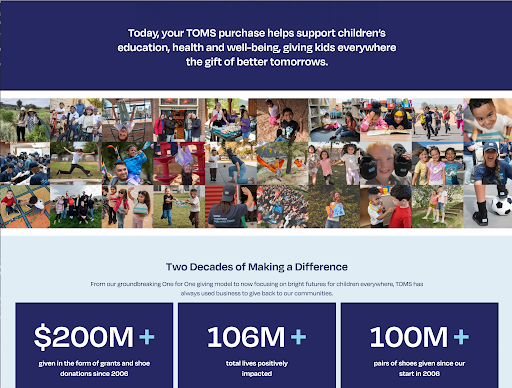
Stated commitment: TOMS says its mission is to “use business to improve lives.” The company’s impact page says its giving model has evolved since 2006, and that today a TOMS purchase helps support children’s education, health, and well-being.
Concrete action: TOMS supports nonprofit partners, including Save the Children, Didi Hirsch Mental Health Services, and GirlForward. It also publishes an annual Impact report, showing that the company has donated more than $200 million in grants and shoe donations since 2006.
Marketing lesson: TOMS became known for its One for One model, but as the company grew, so did its mission. That’s a good reminder to check your own claims. A value statement that was true years ago can become outdated. Don’t write a campaign promise that applied to one season as a permanent offer. Describe what you do now, name your parents, and update your results when you can.
For multi-location businesses, this approach is extremely useful. Review the values claims on your location pages and social profiles a few times a year. If a program has changed, update the copy about it for every location.
A Durable Example of Economic Value: Transparent Pricing
Not every value needs a famous brand behind it. Economic value can be as simple as helping customers understand what they will pay.
Think of a franchise service business that posts starting prices on every location page, explains what affects the final cost, and provides written quotes before work begins. If you value economic transparency, put it into practice by being very clear and sticking to it.
What These Examples Have in Common
Each example starts with a behavior customers can see for themselves. In all of the examples above, they market their program after they already put it into action.
That’s why brand value marketing makes sense. Consistently taking action over time builds the trust and reputation that give a brand its worth.
How to Build a Brand Values Marketing Strategy
The brand values examples above all follow the same pattern: a value, an action, and proof. Now, let’s talk about how you can turn that pattern into an easy strategy for each location to follow.
Step 1: Define Values Your Business Can Demonstrate
Start with three to five brand values. A short list is easier to remember and put into practice.
Once you have your goals in mind, gather input from leadership, franchisees, frontline employees, and customers. Leaders will tell you what the brand wants to be. Employees and customers will tell you what’s actually happening.
Run each proposed value through three questions:
- What decision does this value change?
- What behavior should customers notice?
- What evidence already exists?
Now, sort your answers into two lists. Put the things you’re already doing onto the “established practices” side. Put things you’re working on under “future ambitions.”
Step 2: Understand What Matters in Each Local Market
A value only lands when it connects to something customers care about. Be careful here because that can differ by market.
A location near a college might care more about speed and price, while a suburban location might choose you depending on reliability and family-friendly service. In this case, your core values stay the same, but how you express them will change.
Don’t rely on a single source. Combine customer interviews, online reviews, support issues, and surveys across several locations. Look for repeated themes, not one-off comments. Be careful about social polls, though. Followers and voluntary respondents tend to be your most engaged fans, so they may not represent your full customer base.
Instead of assuming which message works best, run A/B tests to see which ad types resonate most with each market.
Step 3: Connect Each Value to an Action, Proof, and Message
This is where a value becomes useful. For each value, answer some simple questions using this worksheet:
|
Question |
What to Write |
Illustrative Example |
|
Value |
The principle you’re putting into practice |
Transparency |
|
Customer Need |
The concern or question it addresses |
Worry about surprise changes |
|
Business Action |
What the team does differently |
Written estimates before work begins |
|
Evidence |
What proves the action is real |
A published estimate policy |
|
Local Message |
How a location explains it |
A post walking through the estimate process |
|
Owner |
Who is responsible |
Local manager |
|
Metric |
How you’ll know it’s working |
Pricing-related complaints |
Keep this worksheet close. It’ll help keep your messaging honest. If you can’t fill in the action and evidence columns, the value isn’t ready to promote.
Once a row is complete, use this reusable template for captions and replies:
We believe [value]. At [location], that means [action]. Here’s [evidence].
For example, We believe in no surprises. At our Maple Street location, that means a written estimate before any work starts. Here’s how our estimate process works.
Promotions follow the same rule. A discount or limited-time offer should be consistent with your commitments. If one of your values is host pricing, don’t run an offer with fine print that contradicts it.
Step 4: Set Corporate Standards and Local Responsibilities
Multi-location brands need both consistency and local relevance. Corporate teams can control overall brand guidelines, but locations need to adapt what only they know, like staff photos, community partners, events, and local service details.
Next, decide who does what. Here’s a good breakdown to follow:
- Draft: The location or marketing team writes the post, using templates or AI as a starting point.
- Approve: Corporate reviews new claims and sensitive topics. A regional or local manager approves routine posts.
- Publish: One designated person schedules or publishes.
- Respond: The local manager answers comments or reviews within an agreed time period and escalates them when the rules say to.
Step 5: Turn Local Actions into Useful Social Content
Abstract value statements will get ignored, but specific, local proof won’t. Mix in four different types of content, including:
- Service explanations to show how the work gets done
- Employee stories that put a face to a value
- Customer experiences shared with permission
- Progress updates that show what you’re improving and what you’ve learned
Let’s take a look at three hypothetical examples.
Hypothetical example 1: A home-services location explaining written estimates
- Value: Transparency
- Supporting evidence: A published estimate policy and a sample estimate with the customer details removed
- Suggested caption: “No surprises here! Before we start any job, you get a written estimate that lists the work, materials, and price. Here’s what it could look like.”
- Next step: Link to the estimate policy page
Hypothetical example 2: A fitness location introducing who help newcomers
- Value: Inclusion
- Supporting evidence: A scheduled onboarding session led by named staff members
- Suggested caption: “New to the gym? Join Dana and Chris this Saturday morning to walk through the equipment, get familiar with our space, and plan out your first workout. Can’t make it this week? No worries! Sessions run every Saturday morning. See you there!”
- Next step: Invite followers to book their free session.
Hypothetical example 3: A restaurant documenting a local community partnership
- Value: Community
- Supporting evidence: A confirmed donation schedule and/or pickup log, shared with the community partner’s permission
- Suggested caption: “Every week, we drop off our surplus bread to the Eastside Community Pantry. Want to help the pantry, too? Check out their Facebook page to find a list of their most needed items!”
- Next step: Tag the community partner and add a link to its donation page
As you can see, each example starts with something the team actually does. Each caption then explains it in plain language and gives followers a useful next step.
Step 6: Invite Employees and Customers to Contribute
Your team sees your values in action every day. Ask them to share stories voluntarily, like a moment they’re proud of or a customer interaction that reflects their favorite value. Employee advocacy is incredibly popular with consumers. They want to know you treat your staff as well as you treat customers.
The key here is to make employee advocacy optional. The best stories come from people who want to tell them.
Remember to always get permission before you post any identifying customer information, including reviews, photos, or videos. Customers should always know how, where, and when you’ll use their name or image.
Step 7: Use Customer Feedback to Improve the Experience
Feedback is how your values get tested. A reply that says “we care” doesn’t really resolve anything. Instead, follow this complete process:
- Identify a recurring issue: Look for patterns across reviews, comments, and support requests.
- Assign a local owner: One person at the affected location should own the fix.
- Correct the service problem: Change the process, retrain the team, or adjust the schedule so this problem doesn’t happen again.
- Communicate the resolution: Tell customers what changed, but only after you’ve taken the necessary steps to completely correct the problem.
For example, if a customer leaves a review complaining about a long wait, don’t ignore it. Your reply could be something as simple as, “We’re so sorry about that long wait! Thanks for bringing it to our attention. We’ve added an additional team member to the Saturday schedule to ensure this doesn’t happen again. We’d love to see you again soon!” Of course, this reply is only appropriate if the change actually happened.
Keeping up with reviews can get overwhelming, especially for multi-location brands. Use a tool like Rallio’s AI Review Response to streamline the process. It can draft replies to reviews using your AI Playbook, brand voice, and review details. Once it’s drafted, you can forward it to a team to review, edit, or approve.
Always keep a person in charge of sensitive or complex complaints, especially those involving safety, billing disputes, or legal issues. Those are larger problems that only a human can solve.
Using AI Without Inventing Brand Stories
Tools like Rallio’s AI Social Content Creation can turn hours of content planning into a few streamlined minutes, but it needs real material to work from. Give it verified local information, such as an event date, a team member’s role, or a service detail, and ask it to draft captions. Then check its work before anything goes live.
You should never post fabricated testimonials, charitable contributions, customer outcomes, or employee experiences. If it didn’t happen, it doesn’t get posted. A made-up story can damage your brand’s reputation and credibility faster than not telling a story at all.
Common Mistakes that Undermine Brand Values Marketing
Even a strong value based marketing strategy can lose credibility through small missteps. Most of these issues happen because the message gets ahead of what the customers actually experience.
Here are five common mistakes to watch out for:
- Vague promises: Words like “quality,” “caring”, and “community” mean little without detail. Don’t promise what your brand isn’t delivering.
- Copying another company’s values: Borrowed values sound hollow because your team can’t back them up. Start from your own decisions, behaviors, and evidence.
- Posting identical content at every location: Consistency matters, but posting the same post everywhere ignores your local market. Keep those core brand guidelines, but always add local details.
- Promoting commitments locations can’t fulfill. If only some locations offer a particular service, say which ones. Don’t let a corporate post promise what local teams can’t deliver.
- Ignoring contradictory feedback. If reviews say wait times are long while your posts say “fast, friendly service,” customers will believe the reviews over your marketing. Take that feedback as a signal to fix your customer experience.
Some teams also swing too far into their values. You don’t have to choose one or the other. Product features, offers, and values can all work together to create a cohesive marketing strategy.
Support Environmental and Charitable Claims with Evidence
Sustainability and cause-related messages draw the most scrutiny. Broad statements are hard to prove and easy to doubt. Specific claims build trust and work in your favor.
For environmental claims in the U.S., the FTC’s Green Guide says marketers shouldn’t make broad, unqualified claims like “green” or “eco-friendly” because they are hard to substantiate.
For every environmental or charitable claim, spell out these details:
- The activity: What exactly are you doing?
- Participating locations: Which locations take part?
- Dates: When does it start and end?
- The beneficiary: Who or what receives the benefit?
- Limits: Are there caps, minimums, or conditions?
Let’s go back to our coffee example from above for a minute. Saying something like “Fair-trade beans that support farmer families” is a sourcing claim, so it needs support before it goes into real marketing. Back it up with documentation from your supplier, like a fair-trade certification, and check that it covers the beans you actually serve.
How to Measure the Business Impact
Measurement keeps a value driven marketing program honest. It shows whether your actions reach customers and whether your efforts are changing anything. Research can help set your expectations, but it can’t predict your results.
Recent studies show that 68% of shoppers will pay more for a product than in previous years because they trust the brand. While this doesn’t guarantee anything, it’s useful context for measuring your own results.
Track Results By Location
Since different markets respond to different things, it’s important to track your results by location. Start by separating three kinds of KPIs:
- Execution metrics show whether the work is happening. Examples include participating locations, approved posts published, and review response time.
- Customer signals show how customers are reacting. Examples include recurring complaint themes and survey feedback.
- Business outcomes show whether the effort pays off. Examples include repeat purchases, referrals, and qualified inquiries.
Likes and reach help track engagement and attention, but they don’t build trust or drive revenue on their own. A post can earn plenty of engagement and still not move the needle on who walks in the door.
You don’t have to track all your locations’ data yourself. Rallio’s Social Media Analytics lets multi-location brands compare performance by location or roll everything up into one view. It also includes content analytics, review analytics for ratings, trends, and response rate, and downloadable reports.
Start with a Measurable Local Pilot
Don’t launch everywhere at once. Pick one value and a small set of content themes to test at a few selected locations.
Then set up the pilot:
- Establish a baseline. Record each location’s current numbers before you post anything new.
- Assign owners. Name one person to run the pilot and one to track results.
- Choose a review period. Match it to your buying cycle. For example, a restaurant may see signals in weeks, while a home-services business with longer decisions may need a full quarter to see changes.
- Compare similar locations where you can. Look at size, market, and service history.
Always take note of what else is going on. Promotions, seasonality, service performance, and even major weather events can all affect your numbers. A simple before-and-after lift doesn’t prove your messaging caused it. Treat every piece of data as evidence to weigh, not stone-cold proof.
How Rallio Helps Put Brand Values into Practice
Managing your brand’s values across hundreds of locations or social platforms feels like herding cats, but it doesn’t have to. Here’s how Rallio can help you with each piece of the puzzle:
- Prepare brand-informed content: Rallio’s AI Social Content Creation uses AI Playbooks to learn your tone, messaging, and audience. Teams can draft posts from verified posts and local details
- Review it. Track reviews, comments, and DMs across all platforms in one dashboard. Spot misalignments instantly, like a location promoting “speed” when your core value is “thoughtful service.” Rallio flags these gaps and suggests tweaks.
- Schedule it for selected locations. The Social Media Scheduler gives teams one centralized content calendar. They can choose what time to publish and where. The calendar also shows scheduled and published posts in one view, helping local teams avoid gaps and overlaps.
- Support employee participation. Rallio Employee Advocacy lets your team share brand-approved content and their own local images. It also shows who is sharing and how those posts perform.
- Respond to reviews. Rallio AI Review Response drafts replies using your AI Playbook and brand voice. Teams can review, edit, and approve each one before it posts. You can also route sensitive complaints directly to a person.
- Track performance. Rallio Social Media Analytics supports location comparison, content reporting, and review analytics. You can also pair it with your own sales or CRM data to connect activity to outcomes.
FAQs
1. What is value-driven marketing?
Value-driven marketing focuses on delivering meaningful benefits beyond products that align with customers’ core needs and beliefs. It prioritizes solving problems, building emotional connections, saving resources, or supporting shared causes.
2. How is it different from traditional marketing?
Traditional marketing focuses on features, discounts, or flashy ads. Value-driven marketing prioritizes long-term relationships over transactions. While traditional tactics push products, value-driven strategies pull customers in by improving lives.
3. What types of value can brands deliver?
Brands can deliver four types of value: functional (solves problems), emotional (builds joy), economic (saves money), and social (supports causes).
4. Why does value-driven marketing matter today?
Most consumers prefer brands aligned with their values. People ignore salesy pitches but rally behind brands that reflect their beliefs, such as sustainability or inclusivity. With so much happening, leading with your brand values will cut through the noise and put you on top with your purpose-driven audiences.
5. How can businesses start sharing values in marketing?
Businesses can start by clarifying their values and researching what matters most to their audiences. With that information, they can audit every touchpoint, from web copy to paid ads, to ensure their messaging reflects those values.
6. What is the difference between brand values and a value proposition?
Brand values are the principles that guide your decisions, employee standards, and customer service. A value proposition explains why customers should choose a specific offer. Values describe what you stand for, and the proposition describes what customers get.
7. How do you choose values customers can recognize?
Start with values your business can demonstrate. Interview leadership, franchisees, frontline employees, and customers. For each value, ask what decision it changes, what behaviors customers should notice, and what evidence already exists. Choose three to five that pass those tests to start your new strategy.
8. How can franchise locations personalize content while staying consistent?
Corporate sets your brand guidelines, including approved claims, tone, core messages, and escalation rules. Locations can change only what they know, like staff photos, community partners, events, and service details. Clear rules give local teams the room to post customized content with confidence.
9. Do brand values require supporting a social cause?
No. Brand values can focus on honesty, reliability, quality, or service. A cause can be one way to show a value, but it’s optional. If you do make environmental or charitable claims, be specific. Broad claims are too hard to support.
10. How do you measure results?
Track three kinds of measures by location. Execution metrics show whether the work is happening. Customer signals include recurring complaint themes and survey feedback. Business outcomes include repeat purchases, referrals, and qualified inquiries. Likes and reach don’t prove trust or revenue.
11. Can AI help communicate brand values authentically?
Yes, when used as a drafting tool, AI can help you communicate with your customers. Give it verified information, then check names, dates, claims, permissions, and tone before publishing. AI should never invent testimonials, charitable contributions, customer outcomes, or employee experiences. Keep a person in charge of sensitive content and complex complaints.
Highlight Your Brand Values with Rallio
Whether you’re a 500-location franchise or a small business with three or four locations, Rallio makes it easy for everyone to stay on brand and share the values that mean the most to you.
See how Rallio can help your team create, approve, schedule, and measure local social content. Book a demo.

Tyler Phillips is a Creative Marketing Manager at Rallio | Powered by Ignite Visibility, with over seven years of experience in SaaS and social media marketing and more than sixteen years in online video production. Known for his creative thinking and innovative problem-solving, Tyler specializes in designing and executing strategic digital advertising and content marketing campaigns. His passion lies in bridging creativity and data—turning complex ideas into simple, impactful brand narratives that connect, engage, and inspire.