
Quick Summary (TL;DR)
- Entity Trust is the Foundation: Consistency across Name, Address, and Phone (NAP) details verifies your business identity. Discrepancies drop your local ranking power.
- The AI Search Stakes: Because AI platforms like ChatGPT, Gemini, and Google AI Overviews require directory accuracy to build ‘entity confidence,’ your brand information must be structured, consistent, and clearly reinforced across the web.
- Audit & Clean First: Building new citations on top of duplicate or outdated zombie profiles replicates incorrect data. Suppressing duplicates is your primary action item.
- Centralized Governance at Scale: Multi-location brands require corporate control of core listings to prevent data drift, while allowing local teams to manage reviews and photos.
When someone searches for a business like yours—whether in Google’s Map Pack, a local “near me” query, or inside AI search engines like ChatGPT and Google’s AI Overview—the answer they receive is only as trustworthy as the data backing it.
That data is your NAP: Name, Address, and Phone number. When these three elements match exactly across directories, search platforms, and AI knowledge bases, search engines treat your business as a verified, real-world entity and confidently surface it. When they disagree, your local search performance doesn’t just slip—in the era of generative AI search, you risk being dropped from recommendations entirely.
For a single location, keeping this information clean is routine housekeeping. For a franchise or multi-location brand, it is a complex governance challenge that scales with every new unit. This guide details what NAP citations are, why AI search has raised the stakes, how to govern consistency across dozens of locations, and how to choose the right management path for your budget.
What are NAP Citations?
NAP citations refer to your business’s Name, Address, and Phone Number wherever they can be found online, including places like Google Business Profile, Yelp, Facebook, or a local directory.
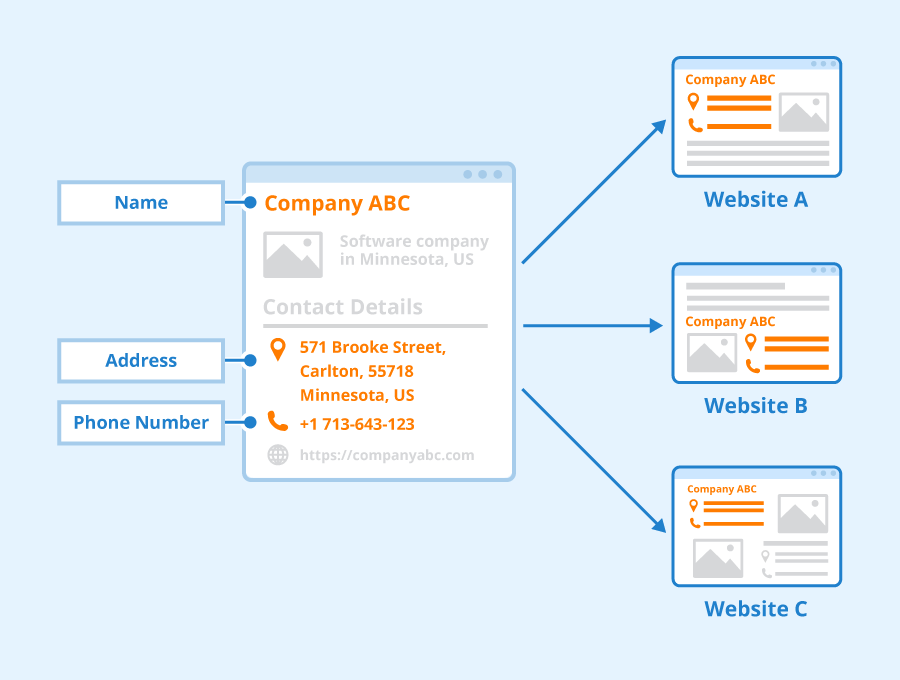
NAP consistency is incredibly important because these citations help search engines know who you are, where you are, and how customers can reach you.
They power services like Google and Bing, maps, GPS apps, voice assistants (including Siri and Alexa), review sites, and local directories.
If your info is wrong, customers might not find you, or worse, they might go to the wrong place. That’s why NAP SEO is so important. People can’t buy from you if they can’t find or trust your info.
My Expert Opinion
I’m not the only local SEO expert who will tell you this: keeping your business info clean and consistent is one of the most important things you can do to rank higher in search results.
NAP consistency isn’t just about looking professional. It’s about being found. You can’t convert more customers, sell more products, or hit bigger goals if people don’t know how to find you in the first place.
Search engines like Google and Bing use your business’s NAP citations (how your name, address, and phone number appear online) as an important ranking factor to decide if your business is trustworthy. If your info is messy or mismatched, they may push you down in rankings or ignore you completely.
If you want to boost your local SEO citations, start with your NAP citations.
NAP Consistency in the AI Era: Helping AI Get the Facts Straight
The way people find businesses online is changing fast. Today, AI search tools don’t just look at one simple list of links. Instead, they gather clues from all over the place. For example, Google’s AI features look at multiple web pages at once, ChatGPT Search checks different search partners, and Gemini relies heavily on Google Maps data.
Because these AI tools pull from so many different sources, keeping your business Name, Address, and Phone number (NAP) exactly the same everywhere is incredibly important. Think of it like giving the AI a clear, easy-to-read map instead of a messy puzzle. When your details match perfectly across your website, maps, and online directories, it stops the AI from getting confused by conflicting information.
To be fair, having matching information isn’t a magic guarantee that an AI will always recommend your business over everyone else. But it does clean up your digital trail. By keeping your information neat and consistent, you eliminate the mixed signals that trip up AI models, making it much easier for them to show your customers the correct details.
The Franchise Problem: Inconsistency at Scale
If managing one location’s listings is a task, managing a franchise system is an operational discipline.
A 50-location brand carries between 2,500 and 5,000 active citation records that must remain identical. If you update a phone system, relocate a few units, or adjust store hours, you are not making a single change—you are managing hundreds of edits across dozens of directories simultaneously. Without a clear governance model, listings quickly drift into inconsistency.
Where the Drift Comes From:
- Franchisee-Created Profiles: Local owners often create their own Google Business Profiles or Yelp listings using non-standard naming conventions (e.g., “Joe’s Plumbers,” “Joe’s Plumbing LLC,” and “Joe’s Plumbing of Tampa” all representing the same brand).
- Legacy and Zombie Listings: Closed locations, old suites, and outdated phone numbers linger on secondary directories, continuing to feed incorrect data to search engines.
- Overwrite Overlap: Franchisees and corporate teams overwriting each other’s updates due to the lack of a single centralized source of truth.
The Scaling Solution: Centralized Governance
To manage multi-location NAP without operational chaos, brands must establish a centralized governance model:
- Define a Single Source of Truth: Corporate controls the master NAP database (usually anchored to the website’s store locator).
- Lock Core Identity Fields: Name, primary category, address formatting, and suite conventions are locked at the corporate level.
- Delegate Flexible Fields: Local owners are given access to manage temporary hours, photos, and local review responses, keeping them engaged without risking core data integrity.
- Establish a Monitoring Schedule: Review and sync listings quarterly to override automatic directory suggestions or consumer edits.
Why NAP Citations are Critical for Local SEO
When it comes to raising local awareness, directory listings and SEO go hand in hand. When your business info is consistent across platforms, it signals to search engines that they can trust you.
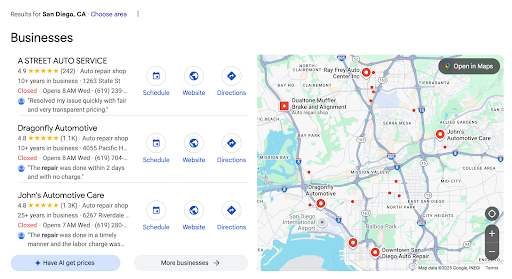
Being trustworthy increases your business’s chances of ending up in the Google Map Pack – those top 3 results in local searches. This is critical for local SEO because most people will choose one of those top 3 results, so you really want your business to be one of them.
It’s as simple as this:
- Accurate citations = more authority and credibility
- Inconsistent citations = confusion and lower rankings
When your local citations are correct, it increases your Search Engine Results Page (SERP) ranking. The higher your SERP ranking, the more phone calls, website clicks, and in-store visits you’ll have.
That’s a real return on investment (ROI). Clean up your citations, and you’ll see the difference.
The Hidden Risks of Bad Citations
Bad citations don’t just hurt your rankings. They cause real problems.
Some of the most common NAP consistency errors include:
- Duplicate listings: Two or more profiles for the same location
- Ghost profiles: Old listings that still show up but aren’t managed
- Spam entries: Wrong info added by bots or competitors
Once this incorrect information starts spreading across the web, it can take off like wildfire. It’s surprising how quickly it can happen!
If you aren’t actively managing your NAP SEO, it could result in frustrated customers, loss of income, and headaches that no busy business owner needs.
What Strong NAP Management Looks Like
The good news is that it isn’t hard to get control of your local SEO citations. It just takes a little work.
Start by focusing on what good local citation management means. No matter where your business is listed online, you should always make sure that all of your business information follows the 3Cs:
- Complete: All fields filled out (name, address, phone, hours, etc.)
- Correct: No typos, old numbers, or outdated addresses
- Consistent: Same info across all platforms
This includes places like:
- Search engines, such as Google or Bing
- Social platforms, including Facebook, Instagram, or TikTok
- Review sites, including Yelp, TripAdvisor, or Angie’s List
- Mobile apps, such as Apple Maps, Google Maps, or Waze
- Voice assistants, like Alexa or Siri
Like most things in digital marketing, your NAP citations are not a set-it-and-forget-it type of task. You should always update your citations in real time whenever necessary.
Making changes isn’t the only time you should monitor your local citations. Making it a habit to monitor them regularly will help to catch (and stop!) errors quickly, before the wrong information makes too much of a negative impact on your business.
What It Costs: DIY vs. Tool vs. Managed
The cost of citation management is primarily driven by your location count and how much hands-on governance you require:
| Path | Target Locations | Average Cost | Ideal For | Pros & Cons |
|---|---|---|---|---|
| DIY (Do It Yourself) | 1–2 locations | Free (Time-intensive: ~20+ hours per location) |
Solo practitioners, micro-businesses | Pro: No software fees. Con: Scales poorly; high risk of manual entry errors and data drift over time. |
| Citation Software Tools | 3–10 locations | $20–$50 per location / month |
Small multi-location operators | Pro: Automated directory syncing and central updates. Con: Requires hands-on management; monthly listing fees recur indefinitely. |
| Managed Citation Services | 10+ locations | Custom pricing (One-time cleanup starting in the $100s up to ~$2,000; ongoing scaled by unit) |
Franchise networks, enterprise brands | Pro: Comprehensive audit, expert duplicate suppression, and centralized database governance. Con: Requires upfront setup investment. |
How Many Citations Do You Actually Need?
You do not need to be listed on 500 minor directories. Citation building follows a curve of diminishing returns. To maximize your budget, focus on getting these three tiers completely accurate:
Tier 1: The Core Services (Non-Negotiable)
These platforms drive the vast majority of direct consumer traffic and downstream data syndication:
- Google Business Profile
- Apple Maps
- Bing Places
- Yelp
Tier 2: The Major Data Aggregators
Aggregators compile business data and distribute it to hundreds of smaller, long-tail directories, apps, and GPS systems:
- Foursquare
- Data Axle
- Neustar Localeze
Tier 3: Industry and Geographic Niches
Directories specific to your vertical (e.g., Angi or TripAdvisor) or your local community (e.g., local Chambers of Commerce). These links and mentions build high contextual relevance.
Cleanup Before You Build
The most common mistake brands make is paying to build new listings before auditing their existing footprint.
If you build 50 new citations while 40 old listings are showing your previous address or a defunct tracking number, you are simply adding noise to the system. The conflicting signals will continue to depress your entity confidence.
Always audit and clean up first. Identify and suppress duplicate profiles, claim unclaimed listings, correct formatting mismatches, and resolve zombie listings before you pay to syndicate net-new profiles.
Why It Matters (and the Risks of Getting It Wrong)
To search engines, Name, Address, and Phone consistency is the bedrock of entity resolution—the process of determining that different mentions across the web refer to the exact same business.
According to the 2026 Whitespark Local Search Ranking Factors study, citation signals account for approximately 7% of the ranking weight in Google’s local pack algorithm. While Google has shifted more controllable weight toward Google Business Profile optimization (32%) and review signals (~20%), citations remain the mandatory trust foundation. Without accurate citations, your GBP optimizations will not yield their full ranking potential.
Furthermore, a study by Yext found that 73% of consumers are unlikely to return to a business if they show up to a location listed as “open” online only to find it closed in person—a direct result of inaccurate directory hours. Conversely, directory profiles that maintain complete, accurate core listing fields receive 62% more clicks than those with outdated or missing details.
For a local business, NAP consistency is a direct trust driver for both search engines and human customers.
How Rallio Makes NAP Simple for Franchises
Rallio serves as a unified, AI-powered marketing operating system that connects every stage of the customer journey, resolving the fragmented tool stack problem for multi-location brands. It replaces multiple point solutions (for scheduling, reviews, listings, and analytics) with a single login, ensuring cleaner database governance and complete listings integrity.
For franchises and multi-location brands, this is a game-changer. Whether you update info at the corporate level or in the field, Rallio rolls it out everywhere – automatically and on time.
Ignite Visibility delivers Rallio through three service tiers:
- SaaS (Self-Serve): Your internal corporate and franchisee teams execute listings and local campaigns using Rallio technology.
- Supported (Guided): Collaborative execution. Your team manages the platform while Ignite Visibility provides the strategic roadmap, templates, and execution support.
- Full Service (Agency): Ignite Visibility manages the entire program, combining elite digital marketing strategy with Rallio’s AI-supercharged execution.
The Rallio AI Technology Framework:
- GBP & Listings Management: Automatically pushes, syncs, and locks location-level Name, Address, and Phone number (NAP) data across major directories, search engines, and mapping applications (including Google, Apple Maps, Bing, Yelp, and Facebook) from a single dashboard.
- AMPLIFY Localized Content (AI SEO): Generates contextually unique local landing pages at scale, bypassing the duplicate find-and-replace text filters that search engines filter out.
- Radius Local Lead Network: A proprietary local demand network delivering pay-per-call or pay-per-lead inbound inquiries with built-in dispute workflows.
- REVV (Review Generation & Feedback): Automates review velocity and customer surveys via SMS and email, directly boosting local credibility signals.
- Agentic Lead Conversion: A 24/7 autonomous AI engine that responds to local inbound leads in under 60 seconds across SMS, email, and voicemail to maximize lead conversion.
- RevIntel: Closed-loop revenue attribution connecting search clicks and local listing engagement directly to customer sales, moving metrics away from CPL and clicks toward Return on Ad Spend (ROAS).
No more drift. No more mismatched listings. Just clean, consistent info that builds trust, boosts rankings, and increases sales. If this is something that you are interested in, contact us at sales@rallio.com.
FAQs About NAP Citations
1. What does NAP mean in local SEO?
NAP stands for Name, Address, and Phone number. It’s the core business info used by search engines to verify and rank local businesses in search results.
2. Why are NAP citations important for franchises?
Franchises have many locations, so consistent NAP citations help maintain trust, improve rankings, and avoid confusion across directories and search engines.
3. What happens if my NAP information isn’t consistent?
Inconsistent NAP info can hurt your search rankings, confuse customers, and lead to lost traffic, missed calls, and negative reviews.
4. How do I know if my Nap Citations are accurate?
Use tools like Rallio’s Directory Listings or local SEO platforms to scan, monitor, and update your NAP citations across all major directories. Always remember to monitor your citations regularly and make any necessary changes as soon as possible.
5. What is a local citation?
A local citation is any online mention of your business’s Name, Address, and Phone number (NAP). These mentions appear on directories, mapping applications, social media profiles, and unstructured formats like news articles or blogs.
6. What is the difference between structured and unstructured citations?
- Structured Citations: Mentions on dedicated business directories built specifically for local data (e.g., Google Business Profile, Apple Maps, Bing Places, Yelp, and Facebook).
- Unstructured Citations: Mentions embedded naturally within other forms of web content, such as a local newspaper article, a blog post, or a neighborhood guide.
7. What is the difference between a citation and a backlink?
A common point of confusion for digital marketers is mistaking citations for backlinks. While both are critical to SEO, they serve entirely different functions:
| Signal Type | Primary Action | Target Metric | Core Purpose |
|---|---|---|---|
| Backlink | A hyperlink pointing from an external website to your domain | Page Authority & PageRank | Tells search engines that your website content is authoritative and worth ranking. |
| Local Citation | A text-based mention of your business Name, Address, and Phone number | Entity Trust & Identity Verification | Tells search engines that your physical business is real, active, and located where you claim. |
8. Do NAP citations still matter in 2026 with AI search?
Yes, more than ever. While their relative weight for traditional rankings has stabilized at around 7%, AI search engines rely on consistent NAP data across multiple sources to build “entity confidence.” Inconsistent listings can cause AI assistants to exclude your brand from recommendations entirely.
Expert Local Citation Management with Rallio
Whether you’re running a home repair company with multiple locations or a fast food franchise, Rallio can help streamline your local citation management.
With our help, it’ll be easy to:
- Be where your customers are
- Measure your brand presence
- Create a bigger impact in your industry
- And more!
Our easy-to-use platform can help you simplify your social media management, improve your local SEO, and start building the type of business you’ve always dreamed of.
Sound exciting? Let’s get started today!

With over six years of experience in digital marketing and client strategy, Megan Lehrich is a VP of Product Customer Experience & Insights at Rallio, an award-winning social media and reputation management platform recently acquired by Ignite Visibility. With deep expertise in franchise and travel marketing, Megan leads strategic relationships across large-scale national and global brands — helping hundreds of local businesses grow through intelligent content syndication, localized social media, and AI-powered engagement tools.