
Not every negative comment is a crisis. Treating it like one can waste time and make things worse. The real challenge in social media crisis management is telling a routine complaint from a serious incident, then responding appropriately.
In this blog, Courtney Swain, Associate Director of Client Services/Product, explains how social media and crisis management work together. You’ll learn how to spot early warning signs and decide what counts as a crisis. She’ll also share tools that can help your team stay organized when things get complicated
What You’ll Learn:
- What is a Social Media Crisis?
- What to Do When a Social Media Crisis Starts
- Why a Crisis Response Plan Matters
- Common Types of Social Media Crises
- Social Media Crisis Management Examples and Lessons
- The Five Stages of a Social Media Crisis Management Plan
- How Multi-Location Brands Should Coordinate a Crisis Response
- How Rallio Supports Crisis Preparedness and Response
- FAQs
TL;DR
- Know what counts as a crisis: Assess severity, credibility, volume, and spread before escalating.
- Act quickly: Check for harm, alert response leads, verify facts, and pause risky content.
- Create a clear plan: Assign roles, approval steps, backups, and after-hours contacts.
- Coordinate locations: Keep corporate messaging consistent while local teams verify branch-level issues.
- Learn from incidents: Review response times, communication gaps, and corrective actions.
- Use tools wisely: Centralized approvals and inboxes help teams manage responses, but people must make the decisions.
What is a Social Media Crisis?
A social media crisis is a situation that starts on social media and threatens to significantly damage your brand’s reputation, customer relationships, or business operations. It typically requires a response beyond your normal customer service.
The trigger doesn’t have to start on your social channels. Something offline can trigger it, like a product recall, a service outage, or an employee incident. It can also begin on someone else’s account, like a customer’s viral video, an influencer’s post, or a news story that tags your brand.
Social media crisis management is the process of handling the incident from start to finish. It covers two connected jobs:
- Crisis management addresses the underlying problem. This means fixing the issue, making decisions, and assigning ownership.
- Crisis communication keeps affected people, like customers, team members, and the public informed of verified updates.
Both matter, because communication alone won’t resolve a problem, and action without clear updates leaves people guessing. A single complaint from an unhappy customer is usually a service issue.
A crisis is different. It spreads quickly and draws attention from people outside your following. It carries real risk to how people view your brand.
Is It a Customer Complaint or a Crisis?
A single credible report can be a crisis if it involves an injury, serious threat, or exposed personal information. On the other hand, a burst of comments about a late delivery may simply be a routine service problem. Your team needs to know how to figure out the difference before deciding who responds.
Judge each situation on these four factors:
- Severity: How much harm could this cause to the general public, your customers, your operations, or your brand?
- Credibility: Is there evidence, such as photos or order details, or is this an unverified complaint?
- Volume: How many people are reporting the same issue?
- Spread: Is it moving across platforms, or reaching media, influencers, or people outside your following?
Save this decision table for help figuring out where a negative comment or complaint falls into your social media crisis management plan.
|
What You’re Seeing |
Example |
Who Handles It |
Next Step |
|
Routine Service Issue |
A customer reports a late order or a billing error |
Customer Care |
Respond and resolve through your normal process |
|
Emerging Pattern |
Several customers report the same problem, or one complaint starts getting shared |
Manager Review |
Verify the facts, watch for spread, and decide whether to escalate |
|
Serious safety, security, or operational issue |
A credible report of injury, a data exposure, or an outage across multiple locations |
Incident Team |
Activate your crisis plan, confirm facts, and issue a first public update |
Classification can change as new information comes in. When you get new facts or information, review each case again.
What to Do When a Social Media Crisis Starts
If an incident is already unfolding, start here. The checklist below will give your team a clear order of action, and the sections that follow cover how to plan for these moments in more detail.
Work through these five steps:
- Assess the immediate harm. Check whether anyone is at risk of injury, whether personal information is exposed, or if a service is down. If so, handle that first.
- Alert the response lead. Notify the person responsible for crisis decisions, along with any help they might need, such as legal, operations, or location managers.
- Preserve records and verify core facts. Save screenshots, post links, timestamps, and customer messages before anything is edited or deleted. Then confirm what happened, who is affected, and what you know for certain.
- Review scheduled promotions and automation. Pause upcoming posts, ads, and automated replies that could look tone-deaf or add to the problem.
- Communication verified information. Tell affected customers what you know, what you’re doing, and when you’ll update them next. Leave out anything that is not confirmed.
You won’t always complete these steps one at a time. Oftentimes, they happen at the same time. This is why a documented social media crisis management plan matters. When multiple team members understand their role and responsibilities, they can all jump in at once.
Pro Tip: If you can’t verify something yet, say so. A brief message such as “We’re aware of the issue and are looking into it.” is better than guessing. Follow up as soon as you have confirmed details, then continue through the stages below to manage the incident from response to review.
Expert Opinion
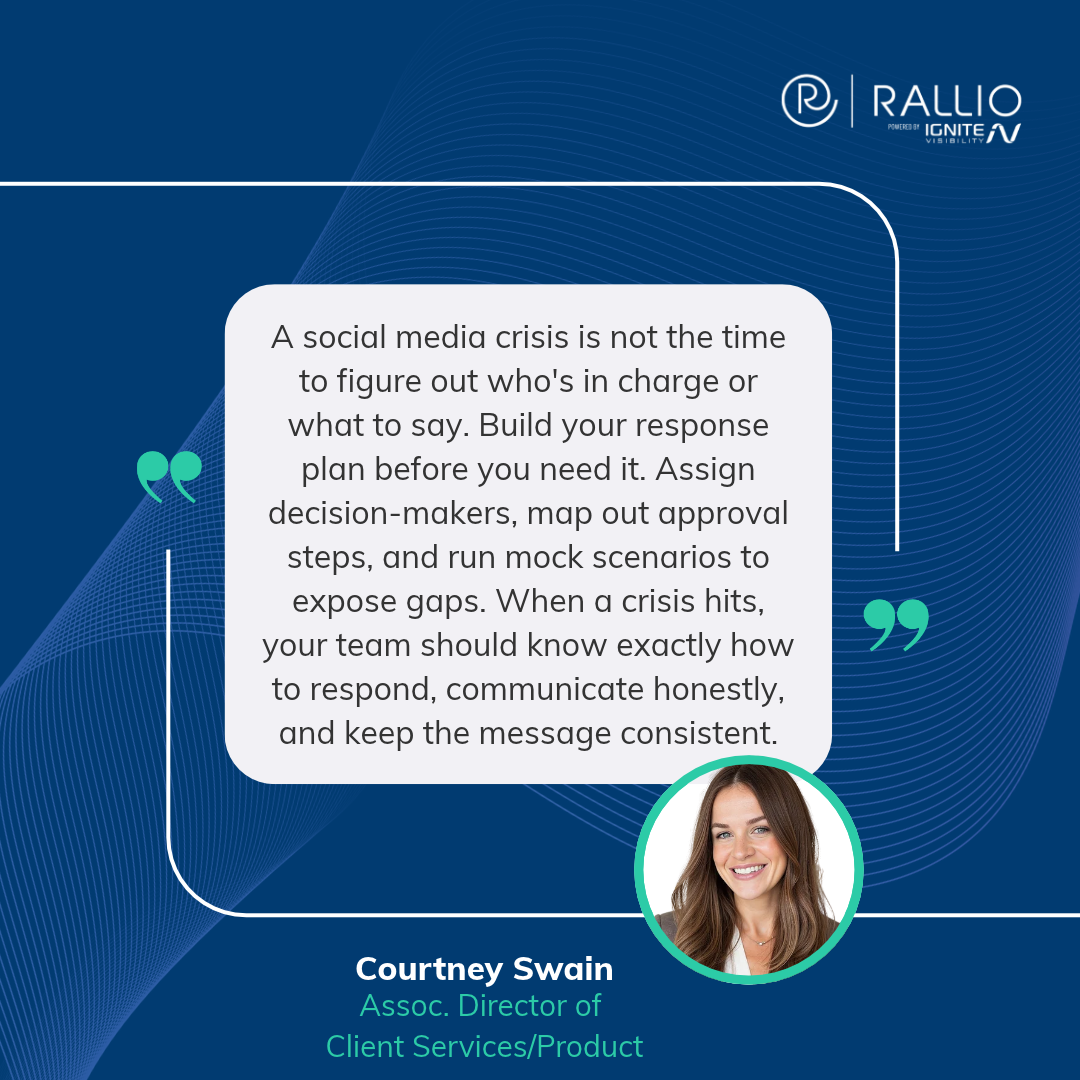
If you work in social media, you know the best time to handle a crisis is before it happens. When you’ve done the groundwork and have a solid plan in place, it gives your team the confidence to act quickly when pressure mounts.
They have a documented social media crisis management plan, named decision-makers for each type of incident, and a clear sequence for who approves what. They’ve also rehearsed situations like this one. Walking through a mock scenario can reveal where handoffs break down while the stakes are still low.
For the tone of your response, borrow from a field that handles high-stakes communications every day. The CDC’s crisis and emergency communication guidance recommends that spokespeople:
- Acknowledge uncertainty. It’s fine to say you don’t have all the answers yet.
- Explain the process. Tell people how you’re finding the answers.
- Avoid over-reassuring. Promising “everything is fine” before you know it is risky.
- Show empathy and honesty. Acknowledge how people feel and tell the truth.
- Keep messages consistent. Everyone speaking for your brand should say the same thing.
The CDC’s short version is “Be first. Be right. Be credible.” This may have been written for public health communications, but the core principles translate well to social media crisis management.
Why a Crisis Response Plan Matters
When an incident happens, your team shouldn’t have to decide who owns what while it’s still unfolding. A social media crisis management plan sets those decisions in advance. This lets your team focus on the problem instead of figuring out the process.
A documented plan gives your team four practical benefits:
- Clear ownership: Each person knows their role, from monitoring and approvals to customer replies and leadership updates.
- Faster approvals: Decision-makers are named in advance, and pre-approved templates give your team a starting point for the first update.
- Consistent information. Everyone who speaks for your brand works from the same verified facts.
- Fewer missed handoffs. A defined escalation path means a serious report doesn’t sit unanswered in one person’s inbox or a single location’s comment section.
These benefits matter most for multi-location brands, where an issue at one site can reach customers at others within hours. A shared plan keeps local and corporate teams aligned, so a response in one market doesn’t contradict another.
Common Types of Social Media Crisis
Crises take different forms, and each one calls for a different first step. Most incidents fall into one of five categories.
Your social media crisis management plan should list each time, who owns it, and what the first response looks like. Use the categories below as a starting point and adjust them for your industry.
Customer Complaints and Service Disruptions
This is one of the most common types of social media crises, especially when multiple customers experience the same issue at the same time. When they start sharing their frustrations online, their individual voices combine into a chorus that’s impossible to ignore.
Respond with confirmed facts and tell people where to find updates. Send individual cases to customer care so they can get a personalized answer.
Public Mistakes
Public mistakes include insensitive posts, accidentally shared confidential information, and campaigns that miss the mark. They also include comments from employees whose profiles show where they work.
Not every case calls for the same response. If it’s content that your brand published, acknowledge the error, correct it, and explain what you’re changing so it doesn’t happen again.
If it’s an employee’s personal statement, check the facts first. Were they speaking for the company? Does the content break policy? Involve HR, leadership, and other internal teams before you respond publicly.
External Events Affecting Brand Perception
Natural disasters, political events, and industry-wide news can make your scheduled posts or past campaigns look out of place. Your brand may have done nothing wrong. It’s just bad timing.
Review scheduled posts, ads, and automation as soon as a major event begins. Then decide whether to pause content or adjust your messaging.
Security and Impersonation Incidents
These incidents involve someone using your brand’s identity or exposing information that should stay private. Common forms include:
- Account compromise: A hacked account posts spam, scams, or offensive content
- Impersonation: A fake account pretends to be your brand or staff and contacts customers
- Privacy incidents: Personal information is exposed in a post, comment, message, or screenshot
Treat these as high priority, even if it’s only one report. Secure the account, save evidence, and warn anyone else who may have been affected.
False Claims, Manipulated Media, and Review Abuse
Not all criticism is a crisis, just like not all viral claims are true. Before you respond, separate them into these two buckets:
- Legitimate criticism: If a negative review has legitimate criticism, acknowledge it and share what you’re doing to fix it.
- Demonstrable false information: Document the complaint, verify the facts, and correct the record with evidence. Report fake or manipulated posts through the social media platform.
Coordinated review abuse is a related problem. Watch for sudden bursts of reviews from accounts with no customer history. Save the evidence and report it through platform channels. Keep responding to genuine customers.
Social Media Crisis Management Examples and Lessons
Real incidents show how these categories play out in real life. Here are some social media crisis management examples you can learn from.
Bioré: Backlash to a Sponsored Influencer Campaign
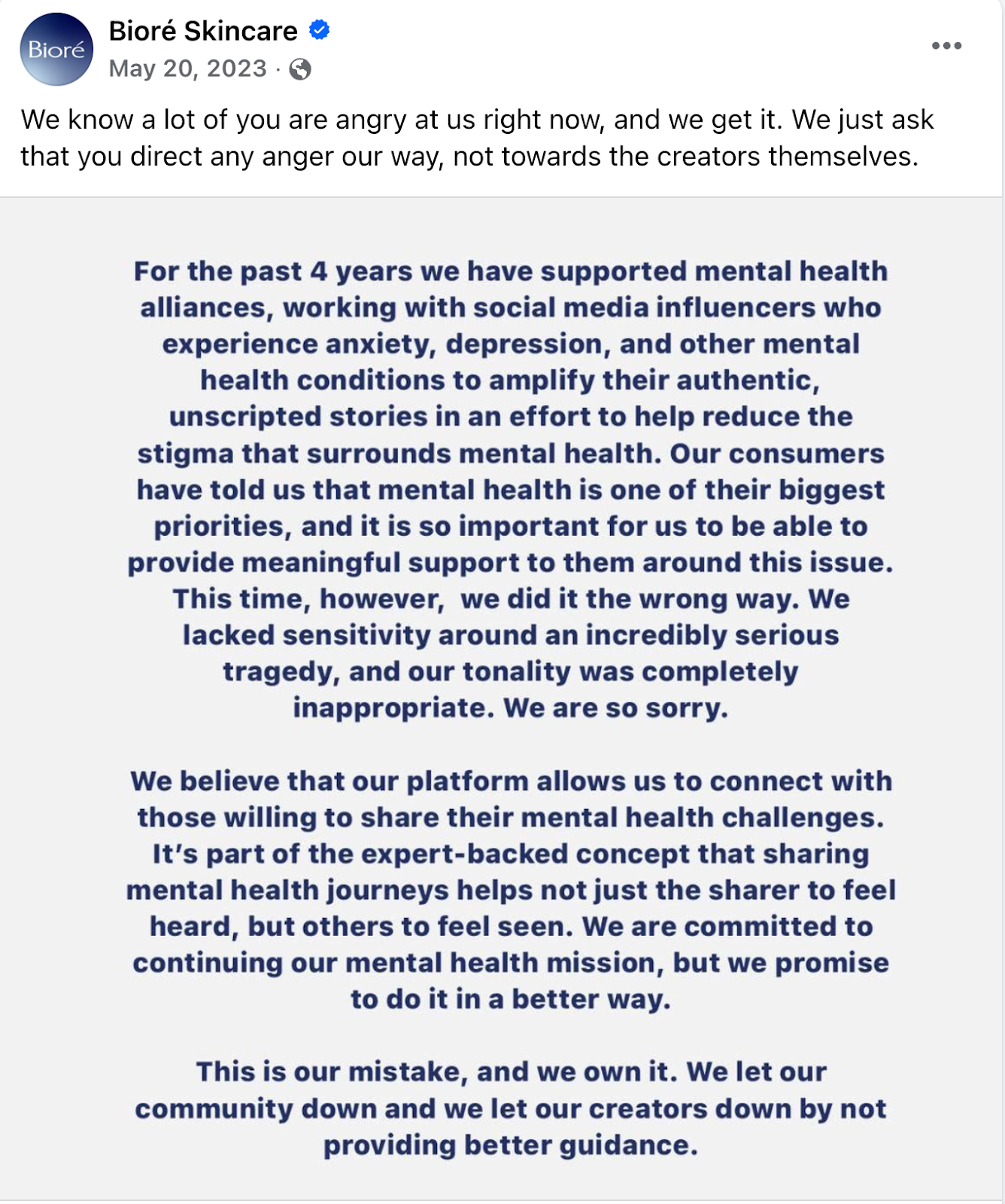
- What happened: In May 2023, a creator posted a sponsored TikTok for Bioré. In it, she discussed anxiety after surviving a school shooting. Many people criticized the ad as insensitive.
- What Bioré communicated: The brand posted an Instagram statement saying the ad “lacked sensitivity around an incredibly serious tragedy, and our tonality was completely inappropriate.” It added, “[t]his is our mistake, and we own it.”
- Action that followed: Bioré reviewed the content and did not place responsibility solely on the creator.
- The lesson: This case is about campaign judgment more than influencer behavior. Sensitive subject matter needs a clear review process before content goes live. If something goes wrong, the brand needs to take the responsibility for approving it.
Google: Gemini Image Generation, February 2024

- What happened: About three weeks after launching image generation of people in Gemini, Google faced criticism over inaccurate images, including historical depictions.
- What Google communicated: On February 23, 2024, Google published an explanation from a senior vice president that said the feature “missed the mark.”
- Action that followed: Google temporarily paused image generation of people. It said it would improve the feature and test it extensively before turning it back on.
- The lesson: Acknowledgment works best when it comes with corrective action. Google named the problem, explained what it was doing, and limited the feature while it worked on a fix.
American Airlines: FAA-Mandated Flight Reductions, November 2025
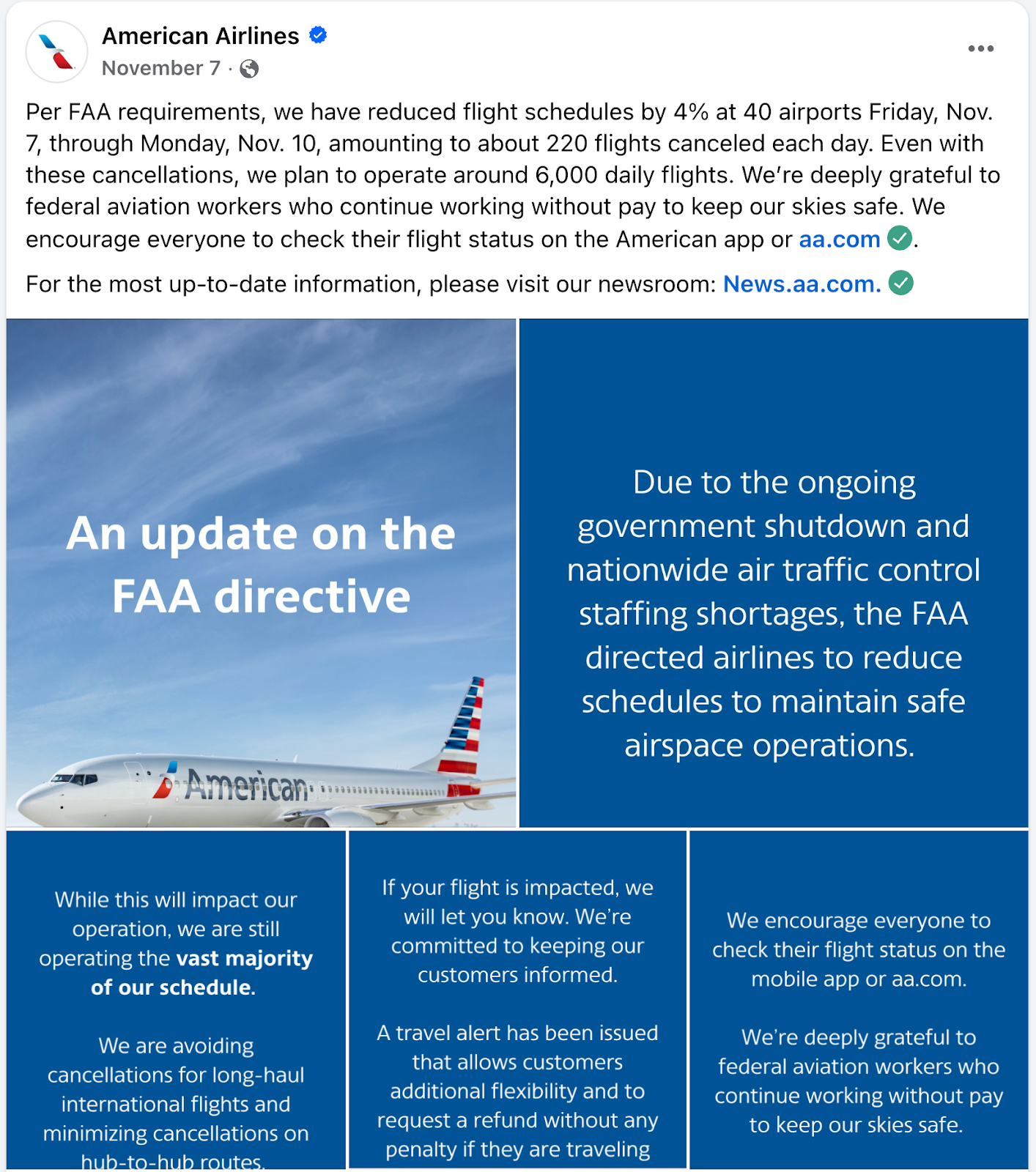
- What happened: During the 2025 federal government shutdown, the FAA ordered airlines to cut flights at 40 high-traffic airports because of air traffic controller staffing strain. The cuts began Friday, November 7, 2025, reducing flights by 4% at those airports. They were set to rise in steps to 10% by November 14th if the shutdown continued.
- What American communicated: On Thursday, November 6, the airline said it expected “the vast majority of our customers’ travel will be unaffected” and that long-haul international travel would stay on schedule. It said it would “proactively reach out to customers who are impacted.” It also told travelers to check flight status on aa.com or their app, and said it would not charge a fee to change plans or request a refund.
It gave specific numbers, too. About 220 flights would be cut each day from Friday through Monday, with around 6,000 daily flights still operating. On Saturday, it warned of “additional widespread delays and cancellations” beyond the FAA-required cuts and said it would notify affected customers.
- Action that followed: American reported that about 12,000 customers had flights canceled on the first day. It said most were “rebooked and reaccommodated.” In a later newsroom update, the airline said it took “unprecedented actions to provide flexibility for customers.”
- The lesson: This was a planned disruption announced ahead of time, so the best communication was early, specific, and honest. American gave customers the numbers and told them where to find updates. When delays grew beyond what the FAA order required, it updated its messaging instead of simply repeating the first one. American also urged Washington leaders to end the shutdown. That is a public position, and whether to take it is a leadership decision your plan should address in advance.
Josie Maran: Communicating During an External Disaster
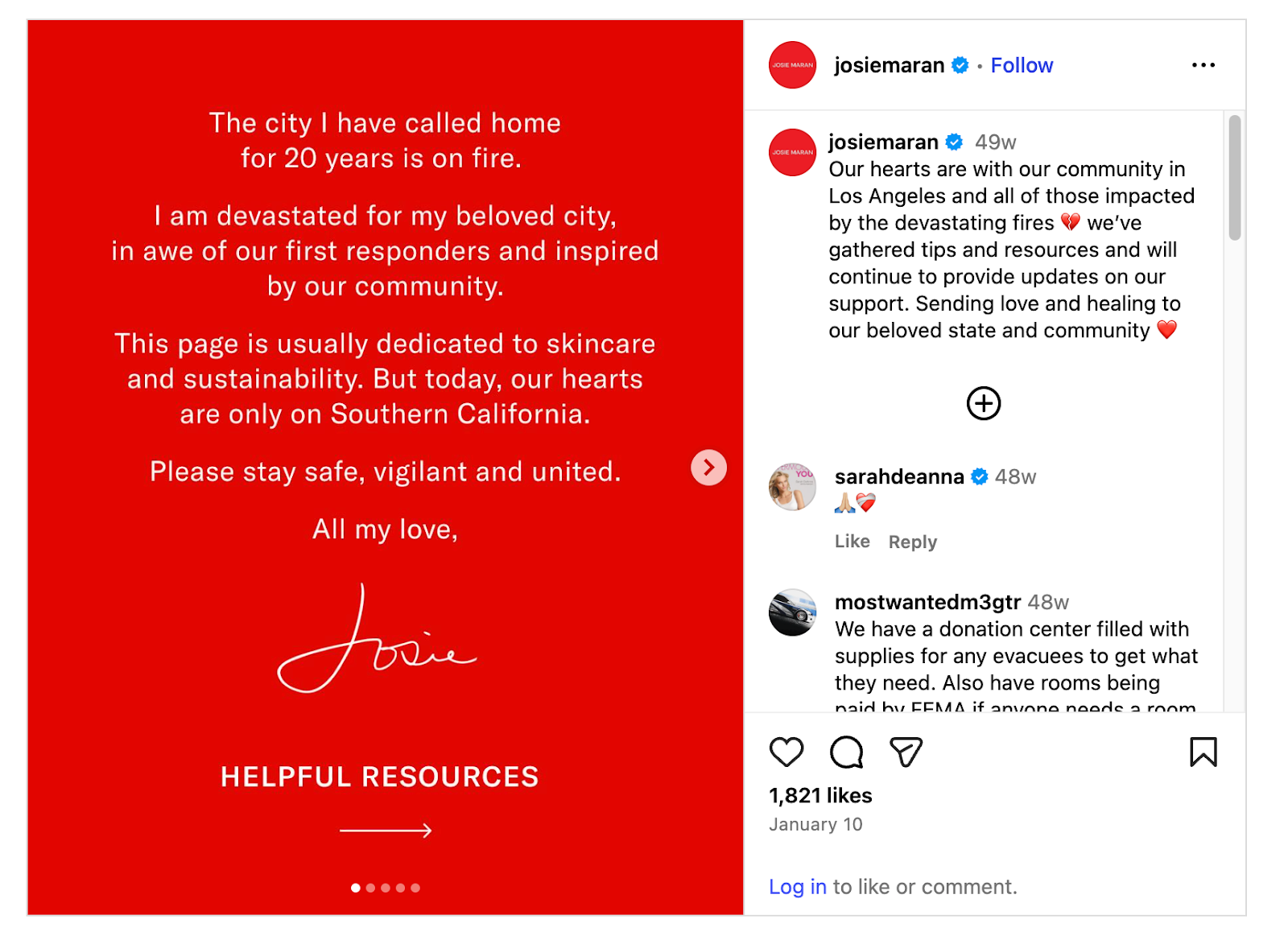
- What happened: In January 2025, wildfires affected the Los Angeles area. This major external event affected customers and teams in the area.
- What Josie Maran communicated: The brand launched Beauty Together, a relief fund inviting other beauty brands, businesses, and creators to participate.
- Action that followed: More than 30 beauty brands joined and committed to donate sales to wildfire relief.
- The lesson: When disaster hits, concrete help matters more than a general statement. A relief effort alone doesn’t show that the brand faced a reputation crisis. It shows how a brand can respond to an event outside its control. Pair this kind of response with a review of scheduled promotions so your regular content doesn’t clash with the moment.
The Five Stages of a Social Media Crisis Management Plan
Most social media crisis management plans follow the same five stages. It’s a practical framework, but not the only accepted model. UK Government Communications, for example, groups its crisis work into three phases: prepare, respond, recover.
Both approaches cover the same work. The five-stage version splits it into smaller steps that your team can assign and check off.
1. Preparation: Assign Roles and Approval Authority
Preparation is the foundation of social media and crisis management. Before an incident occurs, decide who does what and name a backup role for everyone. Here are the roles you’ll need:
- Incident Lead: Makes the final calls and coordinates the team
- Social Monitoring Owner: Watches channels and flags issues
- Spokesperson: Speaks for the brand publicly, including to the media
- Publishing Approver: Signs off on every public statement
- Local Contacts: Location managers who can confirm facts on the ground
- Backups: A named substitute for each role
Next, define when other teams get involved. Bring in:
- Operations for service disruptions
- IT for compromised accounts or outages
- HR for employee conduct
- Legal for privacy and liability questions
- Safety specialists for any risk of injury
Then plan for the hours when people aren’t on the clock. List after-hours contact methods and decide what happens if the primary approver can’t be reached. A common fix is to pass approval to a named backup, then to the incident lead.
2. Identification: Verify the Issue and Assess Severity
Identification means spotting early signals that something may be developing into a crisis rather than remaining a routine customer service issue.
Watch for patterns like rapidly increasing mention volume, negative sentiment spreading across multiple platforms, influencers or media outlets picking up the story, customers tagging friends to spread awareness, or conversations about your brand appearing in places where your audience doesn’t normally discuss you. Evaluate the severity of the issue by asking questions like:
- How many people are affected?
- Is the issue spreading or contained?
- Does it involve safety, legal, or ethical concerns?
- Are mainstream media showing interest?
- Is the conversation staying focused on one specific issue or branching into broader criticisms of your brand?
Separate direct complaints from reposts. Fifty people sharing one post is a different situation from fifty customers reporting the same problem.
Monitor Beyond Your Own Accounts
Monitoring and listening aren’t the same. Monitoring covers the comments, messages, and mentions that directly involve your accounts. Listening looks wider, specifically for untagged mentions, news coverage, and third-party discussions where no one has contacted you directly.
No single dashboard captures every relevant conversation spread across platforms, local forums, and review sites. Identify the sites your tools miss and assign someone to check those places manually.
3. Response: Contain the Problem and Coordinate Communication
After you’ve verified the issue, focus on containing it. Start by reviewing what’s scheduled to publish, then decide what to pause and what to keep.
Check each of these for the incident and the affected locations:
- Scheduled organic promotions
- Paid campaigns
- Employee advocacy content
- Automated replies
Check each publishing system separately. Pausing one social calendar doesn’t pause advertising or other tools. Keep useful service and safety updates running, such as outage notices or location closures.
You’ll also need to:
- Set internal response time targets based on severity and your coverage hours.
- Write an initial holding statement, such as “We’re aware of reports concerning [issue/location]. Our team is [verified action]. If you are affected, [confirmed next step]. We will share another update by [time and time zone], at [link], even if our investigation is still ongoing.”
- Keep updates consistent across channels. If information changes, it should change everywhere.
- Respond to comments without hiding legitimate criticism.
- Escalate safety, security, and privacy concerns.
4. Recovery: Resolve Outstanding Problems Before Resuming Promotions
The next stage is recovery. This part focuses on monitoring how people are responding to your social media crisis management solutions, including:
- Paying attention to how audiences are actually reacting to your communications and actions
- Using social listening tools to track if negative sentiment is decreasing
- Following through on any promises you made during your response phase
You should continue addressing individual concerns that arise even after the initial wave passes. People who missed your crisis communications still deserve responses, and how you treat them demonstrates whether your crisis response was genuine or merely performative.
When appropriate, post a final status update. Keep unresolved individual cases open and continue answering people who missed earlier updates. Don’t promise that trust will come back stronger than before. Follow through on what you said you’d do, and let the results speak for themselves.
5. Post-Crisis Review: Measure and Improve the Response
During the post-crisis review, bring your team together to build a timeline of the incident and evaluate how the response performed. Look at things like:
- Time to detection
- Time to escalation
- Time to the first verified communication
- Approval delays
- Unanswered inquiries
- Completion of corrective actions
- Repeat issues
Use what you’ve learned to update your crisis plan and refine your monitoring systems. Treat every difficult situation as a learning opportunity to strengthen your brand.
How Multi-Location Brands Should Coordinate a Crisis Response
When a brand has multiple locations, an incident can look different at each branch. Clear roles keep corporate and local teams working from the same facts without slowing each other down.
Divide responsibility this way:
- Corporate: Maintains the approved facts and overall message. It also owns the single timestamped source of information and approves any statement that applies to more than one location.
- Local teams: Verify conditions at their location, update their own customers, and report anything new back to corporate right away.
Next, determine whether you’re dealing with one location or something bigger. Ask a few questions:
- Are other locations getting similar reports?
- Do the affected locations share a supplier, vendor, product batch, or software system?
- Did the issue start with a corporate campaign, post, or promotion?
If the answers point to a shared cause, treat it as a brand-level incident and escalate. If only one branch is involved, local teams can lead with corporate support.
Keep updates specific to each location. Say what you’ve confirmed for the affected branch and don’t claim every other location is unaffected until they’ve told you that themselves. A line like “We’ve confirmed this issue at our [location] and are checking others” is accurate and easy to update.
Finally, build your escalation tree to include everyone who speaks for or posts as your brand. Add agency partners, franchisees, and local managers, along with a backup for each.
How Rallio Supports Crisis Preparedness and Response
Even the best social media moderation services for crisis management can’t replace your crisis plan, but they can make it easier to follow. Rallio is built for multi-location and franchise brands. It can support you with:
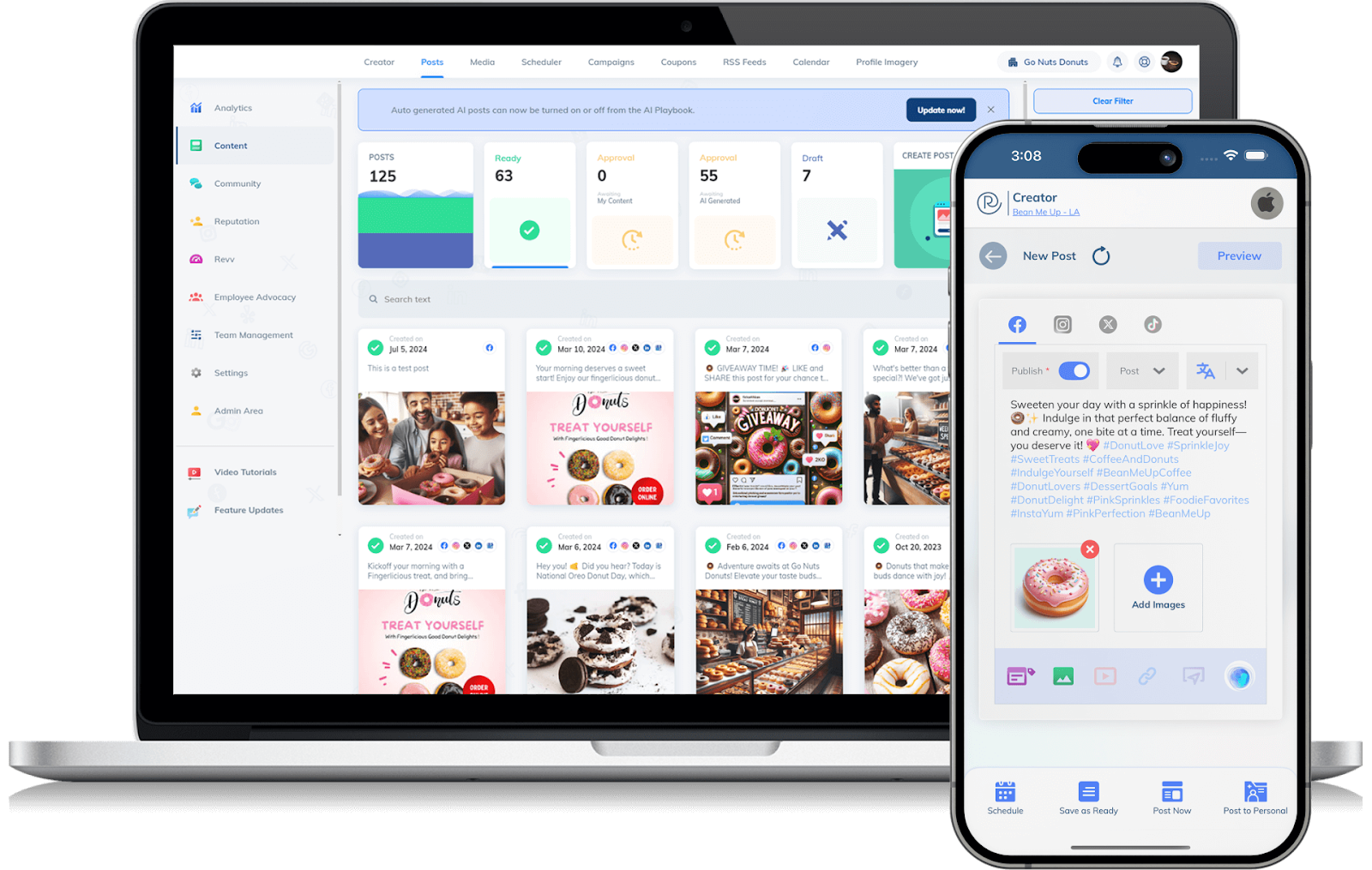
- Location-level permissions: Control who can post, reply, and manage content for each location. This helps you apply the roles and publishing permissions from your one-page plan.
- Content approvals: Route posts through a named approver before they go live. This helps keep statements consistent across locations.
- Inbox and review response controls: Manage messages and review replies from one place, with settings that determine who responds and how.
- Draft and send automated responses: Remember, AI can speed up drafting, but people need to own decisions. Always have your team review, edit, and approve responses before they go live.
FAQs
1. Can one complaint become a crisis?
Yes. A single credible report involving injury, a serious threat, or exposed personal information may need immediate escalation. Always judge each report on severity, credibility, volume, and spread, not just volume alone.
2. How quickly should we respond?
It depends on the severity and your coverage hours. Start by assessing urgent harm, involving the responsible team, and verifying core facts. Set internal response targets based on the severity of the issue. If you choose a one-hour target, treat it as your goal, not necessarily a universal rule.
3. Should we delete negative comments?
Not if they’re legitimate criticism. Reply publicly when it helps others and move personal details offline. Only remove or report content that breaks your documented moderation policy, such as threats, exposed personal information, or spam.
4. What should our first statement say?
Keep your first statement short and verified. Say you’re aware of reports about [issue/location], state the action you’re taking, tell affected people the next step, and name when you’ll update again. Always add empathy that fits the situation and leave out speculation.
5. Should we pause all scheduled content?
Not automatically. Review your scheduled content to see if it seems tone-deaf or if it would add to the problem. Keep useful service and safety updates running.
6. Who responds when one franchise location is involved?
The local team verifies the issue and updates its customers with corporate support. If other locations become involved, then treat it as a brand-level incident.
7. Can AI write crisis responses?
AI can help draft replies, but people should review them. Route sensitive responses through a named approver. Don’t use AI to establish incident facts, approve compensation, or make safety assurances. Those decisions belong to your response lead and the appropriate specialists.
Take Control of Your Social Media Management with Rallio
A crisis plan only helps if your team can actually use it. You don’t need to rebuild everything at once. Start with these three actions this week:
- Check your escalation contacts. Confirm names, phone numbers, and after-hours details for every role.
- Confirm publishing access. Make sure the right people can post, reply, and pause content.
- Rehearse one scenario. Walk your team through a single incident, such as a safety claim at one location. Resolve any issues that might slow down your response.
Each step takes a little time, but together, they will show you what to fix before a real incident starts.
Could your locations coordinate an effective response today? Explore how Rallio can support clearer publishing controls and review-response workflows across your brand and locations with ease.

Courtney is the Associate Director of Client Services/Product at Rallio, Powered by Ignite Visibility. With over four years of experience in SaaS and more than a decade in customer support, she brings a customer-first approach to building strong, lasting partnerships. She leads a support team while managing key client relationships and serving as a bridge between customers and internal product and engineering teams. Her focus is on delivering measurable value, ensuring client satisfaction, identifying growth opportunities, and translating real customer needs into meaningful improvements for data-driven technology solutions.