Rallio – Social Media for Franchises, Small & Local Business

Categories
Reputation Social

How to Engage Authentically With Your Social Media Followers

Social media growth is something most franchise brands, independent business owners and influencers are striving for, but it doesn’t come easy. It requires thought and effort. If you use social networking as simply a means to an end (aka sales) and not as a way to connect with your customers, you’ve failed. You need to work on building relationships with your customers. They will become your brand loyalists and help grow your brand organically. This article will lay down some simple tips on how you can engage authentically with your social media followers on Facebook and Instagram.

Why Engagement Matters

Engaging authentically with your social media followers is important for a number of reasons. First and foremost, it’s the only way to truly understand what your audience wants from you. Social media is an incredibly powerful tool for brands, but in order to use it effectively, you need to know how your audience interacts with your content.

Engaging with followers also allows you to build trust with them. People are more likely to follow brands if they feel like they’re being heard — and conversely, they’ll be less likely to follow if they don’t feel like their voices matter.

Lastly, engagement helps build your reputation as an expert in your field or industry. If people see that others are responding positively to your content or following your brand on social media, they’re more likely to check out what you have going on and give you a follow, too. Your reach can expand exponentially as more and more people engage with you and vice versa.

Related: 4 Big Reasons You Need Localized Social Media Content
Tips for Great Engagement

The way you engage with your followers on Facebook and Instagram is the most important part of your social media strategy. Yet engaging authentically is easy to say but hard to do. It’s a constant challenge because of all the noise on social media, especially if you have a business that relies on word-of-mouth recommendations.

The good news is that it’s not impossible to do well — even if you’re starting from scratch. Keep reading for all the tips you need.

1. Know your audience

The first step to engaging authentically is knowing the audience of each of your social media accounts. For example, if you have an Instagram account for your food truck, knowing that most of your followers are young professionals makes it easier to tailor content that appeals to them — such as pictures of healthy snacks or quotes about healthy eating habits — than it would be if most of them were foodies who enjoy eating fried chicken and potatoes (no judgments!).

2. Write great content

You can’t be effective at social media marketing unless you’re using it to provide value to your customers, and that means creating content that’s useful, interesting and engaging. But what does that mean? How do you write content that’s worth reading? How do you know if your content is working? Let’s explore some strategies for creating great social media posts that will encourage engagement and increase sales.

✔️ The best way to get people talking about your brand is by sharing relevant information that will interest them personally and professionally. If you’re a restaurant owner, show mouth-watering photos of your top dishes. If you’re a florist, share photos of your bridal arrangements for an upcoming wedding. The point is to make it personal to your brand so people will want to engage.

✔️ In most cases, use short sentences and paragraphs. People will be more likely to read your posts if they’re not too long or complicated. There can be exceptions, and sometimes, you may need more words to communicate something important — say, if you’re spotlighting a team member. In those cases, going longer can work to your advantage. But if you’re just sharing a photo of a favorite burrito, the image speaks for itself. Consider the content of the image or video you’re sharing to write your captions appropriately.

✔️ Use bullet points, numbered lists and emojis when appropriate, so readers can scan quickly scan your content and get the gist.

✔️ Use a combination of images, videos and links. Having a mix of content keeps things interesting for your audience.

3. Respond, and do it quickly

When it comes to social media engagement, responsiveness and speed are of the essence. The faster you respond to comments and messages, the more likely you will be to keep your followers happy and engaged. Note: Most customers expect a response to their social media posts within 24 hours.

Among the brands that do respond to customers on social media, research shows that most of them are doing a satisfactory job of answering their customers promptly. Beyond the speed of response, however, there’s another issue: Many complaints are never answered, according to Convince & Convert. The data is enough to have led C&C to create a formula for responding to customers: “Answer every customer complaint. In every channel. Every time.”

It’s not just complaints you need to mind, either. Messages, comments on your posts, reviews and more — whether positive, negative or neutral — all need a response or acknowledgment from you as the brand. Having a social media management platform like Rallio will allow you to pull all engagements into one dashboard so you never miss anything and can be responsive in real time. You can also make use of chatbots and auto-responses on your website and Messenger to let customers know answers to basic FAQ as well as when they can expect a response from you.

4. Be yourself

When you’re establishing a new brand or business page on social media, it can be tempting to try to be everything to everyone. You might start out posting about the things you love and then switch gears when you realize it’s not resonating with your audience. Or maybe you’re trying to be funny one day, then serious the next.

The problem is that this strategy will turn off some of your followers while leaving others confused about who you really are. Instead, aim for consistency and authenticity by sticking with a single voice that feels authentic throughout all of your social media channels.

This doesn’t mean that every post needs to sound exactly alike — in fact, using humor or being serious can help build an interesting persona for your brand — but there should still be some consistency between posts so that people who follow you know what kind of content they can expect from you each time they visit your page or check out one of your posts.

5. Don’t feed the trolls

One of the biggest challenges you may face as a social media marketer is how to deal with negative comments and trolls. It’s important to note that there are two types of trolling on social media: The first is when someone is mean or rude to you in order to provoke a response. The second type is when someone tries to derail your post by commenting about something completely unrelated or unrelated to your brand, perhaps trying to get eyeballs and followers on their own pages.

If you’ve ever posted something on social media and received some nasty comments, you know how demoralizing it can be. You have several options for dealing with trolls, including:

  • Ignore them. As long as their comments are not hateful, inflammatory or vicious, you can ignore the trolls. They will eventually get bored and go away.
  • Block them. This won’t always work because they can create new accounts. But you can always try it as a first step.
  • Hide the user and/or their comments. On some platforms, you can hide comments from view (see this page from Facebook) or hide the user — as on YouTube, where you can hide a user without blocking them. Essentially, any comments they make will go into a void, so they can shout all they want and nobody will hear them. For more on hiding a user or their comments, check on the specifics of each platform.

Engage Authentically to Build Your Brand

If you’re a small-business owner, chances are that you’re using social media to promote your business and build relationships with customers. But if you don’t engage authentically with your followers, you’ll lose their trust and interest.

Engaging with your social media followers is essential for building their trust in your brand. When you engage authentically with your followers, you’re keeping them in the loop about what’s happening in your business. This can help build rapport and strengthen customer relationships.

If you don’t know how to engage authentically, it may seem like a daunting task. Feel free to reach out to us via rallio.com for help creating and managing your social media marketing strategy.

Categories
Social

7 Tips for Better Fall Photos on Social Media

When you’re thinking about taking photos or videos for your business, there are a lot of things to consider. Do you want to show people your product? Will you be using it in an ad or on your website? Are there any specific colors or themes you want to highlight? And when it comes to fall photos, you have even more options. The colors are so beautiful and warm — why not use them to promote your business? We’ve rounded up seven tips for better fall photos that will help you take stunning pictures for your social media pages and attract local business.

1. Use Natural Light

Natural light is the best kind of light because it’s free, easy to find, and, depending on the time of day, flattering for the subject of the photo. You don’t need expensive equipment or fancy lighting setups; just be creative with what you have available to you.

If you’re taking photos outside, try shooting in the morning or evening when the sun isn’t directly overhead or below your subject — this can make for shadows on faces. If you’re indoors, make sure that the light is shining in front of you, not behind. For example, film yourself while facing a window, not the other way around.

2. Highlight Your Community

You can take a picture of just about anything with fall in the background, but why not include some of the things that make your city unique? Think about what makes your community special, like the city hall or a landmark building. If possible, try to find an angle from which the building is prominent in the foreground of your photo.

The best part about this is that it doesn’t have to be a big city. There are many towns and small cities that have a lot of character and charm. If you live in a smaller town, use this as an opportunity to showcase what makes it unique.

3. Keep It Simple

Fall is the perfect time to experiment with different types of photography and techniques. It’s also a great time for creating more artistic images that reflect the season. However, if you want to create an image that will attract customers’ attention and make them want to follow you on social media, keep it simple.

Just because the leaves are changing and the weather is cooler doesn’t mean you have to get fancy with your photos. You can take great pictures with just a smartphone or point-and-shoot camera, along with unique angles and subject matter. For example, if you’re taking a photo of an apple tree at harvest time, try lying down on the ground so that you can get a close-up shot of one of its hanging fruits or the foliage above.

4. Feature Your Fall Favorites

The best way to show off your fall offerings is with a simple photo or video that showcases the product or service itself. This is a great opportunity to feature your business’s fall favorites such as unique products or services, along with special fall promotions.

For example, if you own a bakery, show off some of the seasonal treats you’re offering such as pumpkin pie, apple cider donuts, gingerbread cookies and more.

If you’re a florist, feature some beautiful fall flowers like mums, chrysanthemums and sunflowers. Or if you own a clothing boutique or accessory store, bring out all the scarves, hats and gloves that are perfect for this time of year.

Service-oriented businesses can take before-and-after photos featuring their work or how-to videos explaining how to DIY a project. Adding value to your followers’ feeds ensures they will keep coming back to see your content, helping you increase your engagement and reach.

Related: 7 Proven Video Content Ideas Guaranteed to Liven Up Your Social Media

5. Go Behind the Scenes

Show your followers what it’s like to run a business by including images of employees at work or behind-the-scenes shots of how your products are made or delivered to customers. Make sure there’s something interesting going on in the shot; if all you’re showing are a few products on a shelf, it doesn’t make for a compelling image — instead, try including a customer or an employee in the photo.

These photos come across as more authentic and help to build credibility among your followers. When they see that there’s a real human behind the face of the business, they can begin to connect with you on a more personal level. This is great for local business — and for building your brand on social media.

6. Use Props Sparingly

Fall is a great time for using props — think trees, pumpkins, leaves and anything that will bring out the colors in your photos while still staying true to the season’s theme. Just make sure not to overdo it with too many props or things that don’t fit with your brand; it will just look cluttered and messy. A good rule of thumb is to find things that are already in nature and use them as your backdrop. For example:

Leaves

This is an obvious choice for fall photos because it’s such a popular season for getting outside and enjoying nature. Fall leaves are bright and colorful — just like your business’s social media pages should be! Use them as filler or fill up an entire photo with them to create a cohesive theme.

Pumpkins

If you’re looking for something more festive than just leaves, pumpkins are a great option. From carved pumpkins to fresh ones with stems attached, there’s nothing wrong with having too many pumpkins around when you’re shooting.

Local Trails or Vistas

Have any favorite trailheads or lookout points nearby? Head out with a few co-workers, friends or family members to capture scenes of nature and share them with your followers.

7. Plan Ahead

Be sure to plan ahead so you can take advantage of photo opportunities at local community events, fall festivals, and other local happenings. Are there opportunities to set up a table and conduct some local marketing? Many organizations will let you set up for free or for a small vendor fee.

Remember to mark these events down on your calendar, and be sure to get permission to film at the event or photograph attendees if needed. The Rallio mobile app includes a release form that people can digitally sign and give you instant permission to share on social media. Don’t forget to ask for their Instagram handle so you can tag them — and, hopefully, they’ll share your content with their network, too.

Better Fall Photos Mean More Engagement

From real pumpkins and corn stalks to fall music festivals, there are plenty of ways for you to incorporate the sights and sounds of autumn into your social media photos. With the help of a few props and the right location, you can capture the fun of fall and share it with your followers.

Plus, with better photos, you’ll have better engagement, helping you grow your local business. In the end, you don’t need to invest in a lot of new props or equipment to take better fall photos. With just a few unique items here and there, you can boost your engagement on social media without spending a ton of money. And that’s empowering, especially when it comes to boosting your local business.

Categories
Social

12-Day Social Media Plan

If you’re like most small businesses, your social media marketing is hit or miss. You probably have more work to do than you think. And social media is a marathon, not a sprint, so results don’t come lightning quick.

Tired of spending hours on Facebook, Instagram, Twitter, and LinkedIn trying to be a social superstar only to get lost in the clutter? Want to solve your marketing problems that revolve around social media? Then our free 12-Day Social Media Plan is just what you need. 

Day 1: Establish goals

Social media marketing is a great way to build your business and engage with your customers. But if you don’t have a clear strategy, it can be difficult to measure the success of your efforts. That’s why the first step toward transforming your strategy is establishing clear social marketing goals. Here are several examples of goals you can set:

  • Raise brand awareness and engagement
  • Generate and nurture leads
  • Increase product sales
  • Boost traffic to your website
  • Increase followers on social media
  • Increase customer engagement and loyalty
  • Establish brand authority and trust
  • Enhance the customer experience

Once you’ve defined your goals, you can use them to drive your content production, ensuring that all your posts support the goals you’ve defined. 

Day 2: Define success metrics

How will you measure the success of your social efforts? Decide which metrics you will use to determine whether your strategy is working to support your goals. Consider owned, paid, and earned media as you define these metrics; all three are important elements of your strategy.

For example, you can use audience engagement metrics as an indication of whether you’re making progress on a goal of increasing brand engagement. You could choose to track engagement over a period of time, such as over a month or a quarter, to see your progress.

Day 3: List out your challenges

What challenges are you facing when it comes to social media marketing? Whatever barriers are in your way, write them all down. This could be anything that’s keeping you from making an impact with your social content. Examples of obstacles could be:

  • Having time or resources to post consistently
  • Lack of engagement on posts
  • Drop in organic and/or paid reach
  • Trying to align social with other parts of your business
  • Inability to get quality leads
  • Lack of ROI or understanding of how to measure ROI

Learn more: 5 Social Media Challenges Brands Are Facing in 2022

Day 4: Brainstorm

Take your list of challenges, and start brainstorming solutions to all of them. Get out a big whiteboard, gather your team together, and list every possible solution you can think of to the problems you are facing with your social media marketing. Be sure to consider how each solution will address the challenge and what the end result will be.

For example, one solution to a lack of time to post consistently would be to dedicate an in-house resource to posting, either by hiring a social media manager or adding tasks to someone’s workload. Another option is to use technology like Rallio’s scheduling platform to streamline the work; you can also outsource the work of creating content. Compare costs and potential benefits of any possible solutions to find what works best for you.

Learn more: www.rallio.com 

Day 5: Conduct a competitive analysis

When you’re working to build your brand on social media, it’s important to know what your competitors are up to. A social media competitive analysis will help you see how you stack up against them and identify opportunities to get ahead.

The purpose of a social media competitive analysis is to reveal both your strengths and weaknesses on social platforms, as compared to your top competitors. You can use your social media competitive analysis to: 

  • Identify your primary competitors on social media
  • See which platforms they’re on and how they’re using them
  • Stack-rank yourself against your competitors
  • Do more of what’s working well in terms of content, ads and lead generation
  • Determine any threats to your business on social media, i.e., any potential ways your competitors might outperform you
  • Eliminate underperforming content and ads
  • Add in new content and strategies to strengthen your position on social media

See our five-step process to complete your analysis: How to Conduct a Social Media Competitive Analysis in 5 Easy Steps

Day 6: Conduct a SWOT analysis

It’s easy enough to set up your social media pages and put a checkmark next to that box on your to-do list. What’s not so easy for busy entrepreneurs is keeping up with posting, engaging with their audience, boosting their content, and responding to followers’ questions and reviews.

To avoid falling into a “set it and forget it” mindset, we recommend performing a social media SWOT analysis — identifying strengths, weaknesses, opportunities and threats. Walking yourself through this process will help you stay sharp on social media and amplify your results.

With a social media SWOT analysis, you’re able to analyze your social media marketing strategy based on four quadrants: 

  • Strengths: What are you doing right on social media? What are your competitive advantages, and how well are you conveying them?
  • Weaknesses: What factors might be holding you back on social media? Do you lack internal resources, budget or time?
  • Opportunities: What do you stand to gain on social media? Is it new followers, greater engagement, new leads, brand awareness?
  • Threats: What are some of the external forces that could hinder your progress on social media, such as competitors or economic factors? 

Read our guide: How to Do a Social Media SWOT Analysis and Amplify Your Results

Day 7: Do an audit on your content

Don’t get intimidated by the word “audit.” The idea is simply to identify which content performs the best and worst.

Using a spreadsheet — Google Sheets works well — create columns for the following: 

  • The platform and URL for each platform you’re auditing
  • Follower counts for each account
  • Engagement metrics for each account
  • URL or screenshot of popular content
  • URL or screenshot of anything that’s a dud
  • Any other relevant info you want to know

Neil Patel’s social media audit guidelines are an excellent resource for taking a closer look at all aspects of your social media so you can make improvements where needed.

Day 8: Spruce up your social profiles

Although the content you post on your page is important, don’t neglect the real estate available right on your page. Things like your profile picture, bio and contact information are important to include so you make it easy for people to see who you are and what you’re all about as well as locate your business. Check the following to ensure your profiles are optimized:

  • Use a consistent profile picture across social accounts, such as your logo. This makes you easy to recognize no matter what platform your audience is on.
  • Complete all sections of your profile. Fill out every available field, including your website and address. The more details you offer, the easier it is for people to understand what you do.
  • Include keywords and hashtags. Conduct keyword and hashtag research to identify the words and phrases you want to be associated with as people search conversations, products and services related to your brand.

Day 9: Find your target buyer

In order to advertise on social media, which you should if you want to reach more people, you’ll need to identify your ideal buyer persona, including information such as:

  • Demographics
  • Career
  • Lifestyle
  • Hobbies and interests
  • Purchase behaviors
  • Buying power
  • Pain points (aka problems you can solve for them)

Day 10: Respond to everyone

As you start posting quality local content featuring real, authentic people from your business, and as you start advertising on social media, you are bound to get more comments, questions, messages and reviews. This is a good thing! But you need to make sure you are responding to everyone. Whether you’re thanking people for supporting you, responding to an online review, or simply having a conversation with customers in the comments, it shows people you’re listening and care about your customers when you engage with them.

The flip side is not engaging or responding, and people don’t care for that. If you don’t engage or respond to customer concerns or praise, it’s like ignoring them when they’re knocking on your door.

Day 11: Select content types

Thinking about the buyer persona you created, you can consider the types of content you think your audience would enjoy. From how-to videos to inspirational quotes, there are many different types of content you can post to start engaging more with your audience. 

To make sure you have a good mix of content types, try alternating content types on different days. For instance, maybe on Mondays you post #mondaymotivation posts, and on Thursdays you post #thirstyThursday posts when your team goes to happy hour. Here are some possible content types to consider:

  • Memes and GIFs
  • Infographics
  • How-to videos and articles
  • Polls
  • Contests
  • User-generated content
  • Real-life photos of your team members and customers
  • Pet photos

From there, you can create an editorial content calendar that lays out all of your different content types for the month. Rallio has a built-in calendar tool to make it easy to schedule all of your content for the month and keep it organized. Aim to post at least three times a week for the best results.

Day 12: Review your social media plan and results

The only way to improve your social media is to review past performance. Use the metrics you defined above to measure how your campaigns are doing, which posts are the most popular, and how and when your audience is the most engaged. The more informed you are, the more you can refine and improve your social media plan as you go.

By now, you should have the basic tools you need to tackle your social media marketing.  Follow the steps each day to get the results you want from your social media campaigns — specifically, more leads, more sales, and more followers. Once you’ve developed your own strategy, we think you’ll find that you see better performance from your social media efforts than ever before.

Categories
Social

Brand Storytelling: Guide to Telling Your Story on Social Media

With the rise of social media, we have seen an increase in the number of brands building their own voice in a crowded space. One of the most effective methods of establishing your unique identity is through brand storytelling, the practice of sharing your values, background, and reasons for doing what you do. By telling a brand story in a relatable and engaging way, brands can build a loyal following that engages with their content and is more likely to take the next step in the customer journey. This guide will help you understand the basics of brand storytelling and discover the power behind it for your brand.

What Is Brand Storytelling?

We live in a world where we are constantly bombarded by content. For brands to survive in this environment, they need to find ways to stand out from the crowd. Brands are doing this by creating real connections through storytelling that conveys who they are as a company, what they stand for, and what value they add to people’s lives. 

The power of storytelling lies in its ability to inspire us to take action or change our beliefs or behaviors, but it also can be used as a way to express your brand’s core values. The best brands use their stories to build long-lasting relationships with their customers by creating meaningful experiences for them.

It’s not just about telling your story; it’s about how you tell it — and how you use it to connect with people. Companies that use brand storytelling effectively are able to establish emotional connections with people based on the values they share with them, helping to foster a relationship between brand and customer. Here are five ways innovative companies are using brand storytelling to fuel growth.

Related: 4 Huge Reasons to Start Storytelling on Social Media

1. They understand the value of empathy

Consumers want brands to be more empathetic when interacting with them online — even if they’re just shopping for something as simple as coffee mugs or socks. They want to feel like individuals whose voices are heart, not faceless customers. And because many customers use social media as a customer service channel — via comments, reviews, and DMs — it’s imperative that brands respond to them. Having a dashboard like Rallio that pulls all your customer engagements into one inbox makes the process simple, so you never miss an interaction with a customer and a chance to make their day.

2. They use narrative techniques

From the hero’s journey to the three-act structure, there are many different narrative techniques that brands can employ to tell their stories. These are the kinds of narratives that have been around since the beginning of time, and for good reason: They resonate with audiences and help them to remember a story from start to finish. 

Other writing mechanisms can come into play for a well-rounded story, including anecdotes and metaphors, fairy tales, legends, and any other tools that resonate with you personally. Don’t get too caught up in the technique at the expense of sharing your story authentically; just write what you know as though you are sharing a story with a friend, which leads us to #3 below.

3. They’re authentic

The most compelling brand stories come from a place of authenticity. When you’re creating a brand story, you have to be honest about who you are and what you stand for. This allows your customers to connect with you on a deeper level.

The best brands don’t just talk about themselves, too — they share their story. When people see the real behind-the-scenes moments that led up to the creation of a product or service, they can relate to it in a way that’s real and authentic.

Not only do these stories help build trust between your brand and customers, but they also showcase how much time and effort goes into each product or service. This can lead to greater customer loyalty over time as people get to know your brand on a more personal level.

4. They make it a collaborative effort

Effective brand stories facilitate a connection between the audience and the brand — even making followers a part of the narrative. Getting audience input, interacting with followers via comments and DMs, and sharing user-generated content helps to build a bridge between brand and follower.

Ultimately, your audience needs to feel like they are part of your brand story — not just another follower on your page. They should feel like they are part of something bigger than themselves; that their contribution matters; that they have an impact on what happens next; and that their voice matters in shaping the future of your company, product or service.

Before you start crafting your messages, take some time to dig deep into who your audience is — what makes them tick? What are their values? What do they find important? What makes them laugh? What makes them cry? By getting inside their heads first, you can tailor your messaging with more accuracy.

5. They tailor messaging

When telling your brand story on social media, you can’t simply write it once and post it on every platform. For example, when you’re publishing on Facebook, your posts might include links to your blog, but on Instagram, you need to tell more of a visual story. Tailoring your message for each platform ensures you are reaching your followers where they’re at and seeing what’s relevant to them based on their interests and the networks they follow. With the Rallio platform, you can create different versions of your posts and schedule them out from one place instead of having to log in to each platform to do so.

Related: Content Marketing 101: Engage Your Audience With Great Storytelling

Conclusion

Great storytelling isn’t just for sitting around a campfire; it’s what allows your brand to stand out on social media and build relationships with your audience. The more you use storytelling, the better you’ll get at it — so dive in today! Check with the experts at Rallio about how to use our platform to streamline the process, saving you time and money and helping you tell your brand story both now and in the future. 

Categories
Social

Toolkit: Unlock Social Media Success for Your Local Business

If we’ve learned anything over the past couple of years, it’s that social media is critical to the success of local businesses, creators, and influencers. Yet at the same time, some brands may struggle to find the right strategies for connecting with and influencing their audiences. If that sounds like you, fear not! We’ve put together this toolkit to help anyone from startups to enterprise-level decision makers ramp up their social media success, both now and in the not-so-distant future.

What’s Inside

  • How to: Create Engaging Local Content
  • Tips: Provide Outstanding Customer Service on Social Media
  • Checklist: Find the Right Content Mix for Your Brand
  • Video: Increase Exposure With Both Paid and Organic Posts
  • Tool: Get Organized With the Rallio Dashboard 

How to: Create Engaging Local Content

You may already know that people are more likely to make purchases from companies they feel are relatable. That’s why it’s so important that your social media marketing strategy includes local content. If you’re not posting local content on your social media pages, you’re missing out on opportunities to connect with your audience, build trust, increase leads, and ultimately boost your sales.

While it might sound complicated to create local content, it’s quite simple. The steps look something like this:

  1. Snap a photo of someone or something in your store, at home, or behind the scenes of your business. You can also film a short video.
  2. Upload it to your social media channels of choice. We recommend, at a minimum, posting on Facebook and Instagram for B2C businesses and including LinkedIn and Twitter if you’re looking to develop B2B and professional relationships.
  3. Add a caption. Tell your audience what’s going on in the photo or video. Add hashtags when posting on Instagram. Tag other people and/or businesses to increase exposure.
  4. Post your photo or video. You’re almost done!
  5. Go back later and check your post analytics to see how it performed. Make any tweaks as needed to the content. Boost at least one post per week to increase its reach.

Here are some ideas for engaging local content:

  • Create posts based on calendar events, such as holidays and national celebrations
  • Share relevant news stories and blog posts on Facebook
  • Post pictures and videos of your products in use
  • Link to stories about others in your industry
  • Show “before and after” photos if your business lends itself to that type of content

Tips: Provide Outstanding Customer Service on Social Media

Social media has become the go-to place for people to share their experiences and get feedback from others. If you’re a business, you must monitor your social media channels for customer service opportunities.

When a customer has an issue with your product or service, they may be more likely to reach out on social media than to call the company directly or submit a complaint through its website. Here are some tips for providing outstanding customer service on social media:

  • Be responsive. As soon as you see a question or comment from a customer, respond to them as quickly as possible. The faster you respond, the better the odds they’ll be satisfied with your response and won’t escalate their complaint any further.
  • Be helpful and proactive. Your ability to help customers goes beyond just answering their questions; sometimes it means anticipating their needs before they even ask for them! For example, offer to credit their account with $10 for their troubles.
  • Respond to positive comments and reviews, too. This shows you’re listening and you’re grateful for your customers.
  • Use technology to help you manage the process. Rallio’s dashboard pulls in comments and reviews and allows you to respond to them directly.

Related: Responding to Online Reviews in 3 Easy Steps

Checklist: Create a Balanced Mix of Content for Your Brand

Your social media content mix is the combination of different types of posts you share on your social profiles. It’s important to have a good balance to reach your audience with the right type of content at the right time. To create a balanced mix, make sure you’ve checked off the items on this list so you know what type of customer you’re trying to reach. This list will also help you with creating targeted ads.

  Identify audience demographics such as age range and geographic location

 Develop messaging that this audience will find relatable and authentic

 Determine which social media platforms your audience uses the most

 Take photos throughout your location of team members, customers, products, etc.

 Film four or five short videos to use throughout the month 

 Gather customer testimonials

 Create a content calendar that includes key holidays and events

 Identify two dates per month when you will go “live” with your audience

 Create four different Instagram Reels and/or Stories

 Curate four different inspirational quotes that will resonate with your audience

Here are some questions to ask yourself as you go through the checklist:

  • What are your business goals?
  • What do you want people to do after they see your post — i.e., what’s your call to action? Buy something? Sign up for a newsletter? Share it on their profiles? Whatever it is, make sure this is clear in every piece of content you create so that you can measure success.
  • Are there any key performance indicators (KPIs) you’d like to use to evaluate success?
  • Is there someone on your team you can rely on to be a dedicated social media manager, or do you need to outsource your social media management? At a minimum, having someone who can take photos will help you stay on track.

Tool: Get Organized With the Rallio Dashboard

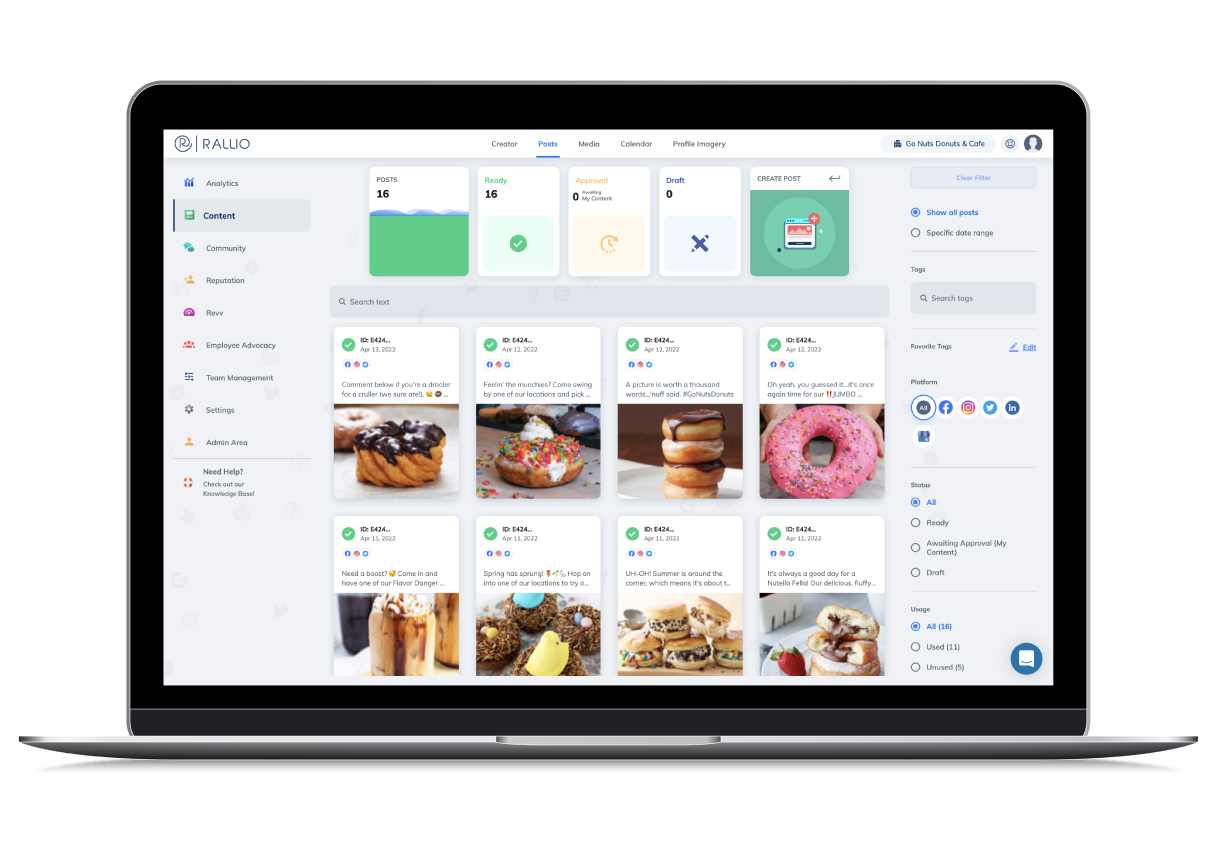
Rallio’s social media dashboard is a great tool for managing your business’s social media accounts. The dashboard allows you to schedule posts across platforms, view analytics, engage employees in advocacy, respond to reviews and comments, and monitor what’s going on with your brand — all with a single login. Easily monitor your follower growth and engagement rates, as well as view detailed analytics for each post. If your business has multiple locations, Rallio allows you to schedule and syndicate content across locations.

Our dashboard is a powerful tool that helps you get organized with your social media marketing and can help you uplevel your efforts. You’ll spend less time trying to organize your efforts, leaving you more time to engage with your followers, and focus on your business. Here’s how:

  • Activate Rallio’s Local Tech and Local Team to ignite the engagement of your local pages. 
  • Engage REVV, our reputation management app, to add massive numbers of positive reviews to your online reputation. 
  • Finally, use our local listings management solution to maintain consistent location data across the web and give Google confidence to list your locations at the top of the search results.

It’s the ultimate solution to maximize your local social media engagement and improve your local search results. Ask us about the details, bundled pricing solutions, and case studies to prove the measurable results.

Video: Increase Exposure With Both Paid and Organic Posts

There are two main ways to increase your exposure on social media: paid and organic posts. What’s the difference between the two? Organic posts are posts that are shared by users who see your post and decide they like it enough to engage with it or share it with their friends or followers. Paid posts are ads that pop up on someone’s screen when they’re browsing Facebook or Instagram and may include both boosted and sponsored posts.

Paid Posts

Paid posts are the easiest way to get more exposure for your business on social media. You have two options when purchasing paid posts: boosted posts and ads. A boosted post is simply a regular post for which you pay to increase its exposure, while an ad is a completely separate piece of content that uniquely promotes your brand and requires an Ads Manager account connected with your business page. Both can be used to promote your business and website, but they’re different enough that you should consider using both if possible.

Organic Posts

Organic posts are free but take a lot more time and effort to create than boosted posts do. However, they can help build credibility with followers by showing them that you care about their interests and opinions — even if they don’t always respond or share what you post. You can also increase your reach with organic posts by engaging employee advocates; Rallio enables you to provide limited logins to employees on your team so they can upload and share more content.

Start Using Your Toolkit Today

The future of social media is interwoven into the fabric of our society and will continue to grow and expand. As such, you must investigate and adopt new tools and tactics to keep up with these changes. Social media marketing requires that you become a curator for all social networks, using social listening and insights to keep current, enhancing your content with multimedia and live-streaming, as well as engaging your customers in fresh ways. Hopefully, this toolkit has provided you with some practical tips for getting the most out of your social media engagement and taking your marketing to the next level.

Categories
Social

Spring Clean Your Social Media in 4 Easy Steps

Social media can be a powerful tool for your company. However, if you haven’t spruced up your social accounts in a while, it’s time to take out your spray bottle and squeegee and get to work. Take a look at four quick ways to spring clean your social media accounts, and get your social media marketing working even harder for you as we head into the summer months.

1. Update Your Branding

You may be tempted to use a selfie for your profile photo, but that’s not the best way to make a great impression on your audience. Use a professional logo that highlights your brand and helps people recognize you wherever they see it. Be sure to use the same photo across all of your profiles so your audience can easily recognize you, no matter the platform. “This not only ensures consistent branding but also helps make it easier for people to recognize you when they see your profile image on each of the different social media platforms,” notes Social Media Today.

2. Secure Accounts

Review the access and privileges across your accounts. Remove any employees who are no longer with your business, and make sure all current employees have access only to the information they need to do their jobs well. This way, you can avoid inadvertently giving them too much access, a recipe for problems down the road.

For current employees you wish to give access to your Facebook page, you have the following options for page roles:

  • Admin. This is the highest level of access; admins have the ability to manage all aspects of a Facebook page, including creating ads and viewing analytics.
  • Editor. This is one step below an admin; an editor can do everything an admin can except assign page roles.
  • Moderator. A moderator has more limited access; while they cannot post content, they can respond to messages and comments, create ads, and see Facebook insights, for example.
  • Advertiser. As the name implies, an advertiser can create ads and view insights.
  • Analyst. An analyst has the least amount of access; they are restricted to viewing insights and cannot create ads or post to the page. An analyst view can be helpful if you want a third-party expert to look at your campaigns without giving them access to your page.
  • Custom page roles. A combination of roles as per your specifications.

Related: 5 Ways to Use Social Media Marketing to Promote Your Franchise

3. Audit

If you’re looking for ideas on how to improve your social media marketing strategy, you might be wondering what to do with all of those old posts. Though it may be tempting to delete them and make way for new content, there’s a lot of valuable insight that can be gained from reviewing past posts. Check out posts from the past and ask yourself:

  • Which topics are resonating the most with my audience?
  • What kind of content do my followers respond best to?
  • How many people did I reach?   
  • How many likes or shares did each post get?
  • Do people comment on or share my posts? If not, why? If so, what makes this post so engaging?
  • Did any of my posts go viral or get picked up by other blogs?   
  • Did any of them end up being featured on other sites (for example, did one of my photos get used by an influencer)?   
  • Did any of my articles rank well in Google search?
  • Which posts have outstayed their welcome?
  • Which channels drove the most traffic and conversions? Which ones underperformed?
  • What types of images work best? What captions work best? Are there any themes in my photos that might make sense as a series of posts?
  • How many times per day should I post (and at what times)? How often does my audience engage with my content across platforms (Facebook, Instagram, Twitter)? How do these numbers compare to competitors?

Yes, this is a long list of questions, but it’s necessary to answer them all as you’re working to spring-clean your social media.

4. Set New Goals

Based on the insights and analytics you see on your social media posts, you can use that information to make your new content even better. Take a look at your existing key performance indicators to set new goals that will take your social media marketing to the next level. The most basic KPIs are related to engagement and follower growth, such as:

  • Number of likes and saves
  • Number of shares
  • Number of comments
  • Number of new followers

There are also more advanced KPIs that can help you get even more insight into how people interact with your content and what they think about it, including:

  • Unique visits. This metric tells you how many different people visited your site from your social media posts. If you have multiple sites or landing pages linked to from your social media accounts and want to know how many people visited each one in total, this is the KPI for you.
  • Brand awareness. Reach and impressions are two of the most popular metrics used to measure brand awareness. These measures indicate how many people saw your posts, but they don’t tell you whether or not anyone actually saw them. To measure brand awareness, you’d want to use an image KPI like click-through rate (CTR) or engagement rate.
  • Sales. You can also use social media to drive sales by tracking your conversion rates — the number of people who convert into customers after seeing a particular ad or promotion on social media — and ROI (return on investment). Your conversion rates will vary depending on your industry and audience but should be tracked across all platforms so you have a good idea about what works best for your business.

Spring Clean Your Social Media for Better Results

Use these four tips to take a fresh look at your social accounts and spring clean your social media marketing, especially if it’s been a while since you analyzed your accounts. By doing this, you can make sure your efforts are as effective as possible both now and for the remainder of the year. If you need any extra tips as you spring clean your social media, reach out to our experts via support@rallio.com and we’ll help you get on track.

Categories
Social

8 Reasons You Need One Social Media Marketing Provider

Let’s face it: Social media can be daunting for businesses. And trying to keep up with all of its changes is challenging — especially when you’re also running a business! To make matters worse, you might have a lot of different people from different agencies working on your social media marketing, and it’s causing confusion, mistakes and frustration. Below, we share eight reasons you need one social media marketing provider for all of your social media marketing needs — and why Rallio is the solution of choice for top franchise brands.

1. Consistent Brand Message

Consistency is key when it comes to your brand message, and a single provider can ensure this consistency. When you have one social media marketing provider, you create continuity and control for the brand.

When you have multiple social media marketing providers, it is quite possible that they will have different ideas regarding the brand image or what type of content to release. This can lead to inconsistencies in the brand message and cause confusion among your customers.

2. No Agency Chaos

The ability to manage social media and digital marketing activities for multiple offices is a key component of any successful multi-location campaign. And it’s even more important when it comes to social media, because of the sheer volume of accounts that need to be managed.

At Rallio, we work with clients who have hundreds or thousands of locations. With so many franchisees, they typically need a way to syndicate content from the top down and engage their owners in the social media marketing process. They also want a better way to monitor their data and roll-up analytics across all locations, so they can make smart business decisions and replicate successes that will benefit the entire system. Keeping everything under one roof at Rallio ensures everyone is aligned.

3. Tier-1 Training and Support

Rallio support will typically become the first level of contact for any questions related to the platform or their Rallio Local services. Because we provide both the technology and the team for our clients’ social media marketing needs, it eliminates the middle person. This way, support questions get handled internally in minutes rather than forwarded to an agency, causing delays and confusion. 

Related: Top 4 Benefits of Using a Social Media Management Platform

social media management provider platform

4. No Setup Required

Because the Rallio technology is already set up, the onboarding process is streamlined and quick, entailing meet-n-greets, strategy calls and training videos to get owners up and running. 

For many clients, this is where they can sit back and let Rallio take it from there. However, the platform also allows owners to have full control over their social media presence as well. They can monitor performance, approve posts in real time, and write their own content as needed.

5. Volume Discount Pricing

Rallio Local provides franchises with top-tier social agency work at a fraction of the cost to them due to volume pricing from brand-wide adoption. It’s a scalable solution that helps franchises:

  • Create authentic, effective and engaging local social media content
  • Simplify online review responses and reputation management
  • Manage and engage their audiences on social media, including review sites and local directory listings
  • Create advertising campaigns with best practices baked in

6. Minimizes Corporate Efforts

Rallio Local will use the digital brand assets that are already provided by Corporate in the Rallio platform. This process is much more efficient than working with multiple agencies, which typically put additional demands on the Corporate team to supply the same assets to each of them. 

This demand can become quite substantial when you’re working with numerous agencies. Further, Corporate can easily approve locally generated content with a click within Rallio, rather than via a different method with each agency. 

7. Integrated Mobile App

With the image library in the Rallio mobile app, franchisees are able to upload images and easily send them for approval. The Rallio Local team uses the approved images to create and boost highly engaging approved local content. Locations also have the ability to activate employees as brand ambassadors and expand their use of user-generated content. Plus, local images roll all the way up to Corporate, too!

8. Legal Protection

With the liability digital release form in the mobile app, franchisees can capture mobile images of employees and customers with a proper digital release form in order to use them risk-free on social media. The app provides a form for a digital signature in the moment. Most agencies that create local content do so with risk, as images captured often don’t provide proper release and publishing rights. 

Choose the Top Social Media Marketing Provider

Many franchise systems make the mistake of using multiple social media marketing providers for their business. Instead, we recommend going with a full-service provider like Rallio that offers a wide array of services, including social media management, strategy and content creation. Plus, our platform plugs into your current workflow and provides an assortment of tools to customize your approach to social media marketing.

Choosing a single provider streamlines the process, avoids major headaches, and makes your overall marketing strategy more comprehensive, effective and efficient. To find out more, head over to rallio.com or send us an email at sales@rallio.com.

Related: Case Study: Why Localized Social Media Matters

Case Study: Rallio Local

Categories
Social

Top 4 Video Marketing Trends

Video marketing is one of the largest untapped markets that’s ready for growth. According to Wyzowl research, video remains a key priority for marketers, and you can see why: The amount of video content watched has almost doubled since 2018. 

With more and more people watching videos, companies are responding to the demand, both with video content and video advertisements. This means that video marketing is now a must in business if you want to stay competitive. So with so much video content out there, how do you make yours stand out from the rest?

If video is still a mystery to you, you aren’t alone. While video marketing is not new, it’s only recently started to enter mainstream use in small-business marketing. And although we are seeing more and more videos on websites these days, many website owners don’t realize the importance of using video for their businesses. 

Make today the day that you tackle your video marketing by tapping into the following 4 trends, even if this feels like unfamiliar territory. With video marketing, you can cut through the noise online and reach your target audience with a major impact. 

1. Live Streaming

Live streaming is a great way to engage with your audience in real-time and show them who you really are. It’s candid and personal, allowing consumers to interact with your brand directly, ask questions, get answers about products or services, and acquire information right at the moment when they need it.

Unlike the static posts that used to dominate social media feeds, live video lets viewers interact with your broadcast through comments and reactions, and you can respond back. It’s an authentic and interactive experience that builds stronger communities.

And it goes beyond connecting with your audience: Live video is also an increasingly powerful tool for reaching new people. Facebook prioritizes live videos in newsfeeds so that publishers and creators have a better chance of getting their content discovered. 

And when you go live, the notification will alert your followers so that they have the option to tune in right away or later — this makes it easy for fans to join a broadcast at the perfect moment, just like tuning in to your favorite show. (You can learn more about how Facebook distributes video content in this link.)

2. Stories and Reels

In a similar way as live-streaming, Stories and Reels create a more personal connection with your brand, even if it’s not live. The difference is largely that these formats are meant to be more casual, showing snippets of your company’s life throughout the day. In addition, Stories can include both video and static content.

Stories also allow you to interact directly with your followers using the integrated features. You can ask questions, post polls, and ask customers to tag you in their own Stories to generate more engagement and reach.

Reels are more similar to what you would see on TikTok and, unlike Stories, do not disappear after 24 hours. Your Reels can live on your profile as a post indefinitely unless you choose to remove them — and you can also share your Reels to your own story.

Both Stories and Reels have their place, so don’t be afraid to mix things up. For a side-by-side comparison between Stories and Reels, click here.

Related: Top 5 Social Media Trends to Watch in 2022

3. The Link Between Video and SEO

Videos are an increasingly important part of SEO strategy. Inc.com reports that videos are 53 times more likely to generate a first-page ranking than traditional SEO techniques, according to a Forrester Research study. 

You know that a video is worth more than a thousand words, and the same goes for your SEO strategy. It’s not just because our attention spans have shrunk and we’d rather watch videos than read about something. It’s also because:

  • Videos are more likely to be shared across social media platforms (which means more traffic)
  • Videos build trust with your audience by putting a human face on your brand, increasing your page’s relevancy and “stickiness”
  • Videos increase the likelihood that people will click through to your site after they find it in the search results (which helps improve your rank)
  • Videos boost conversions, encouraging more people to take the action you want to take (such as making a purchase, downloading your content, joining your email list)
  • Video is popular on mobile. InVideo reports that 92% of people who view videos on their mobile devices share them with others.

To make sure your video content is optimized for SEO, focus on the following three areas:

  • Relevancy — Make your videos relevant for your audience by tapping into their needs. Answer their questions, entertain them, and educate them on topics of interest to them.
  • Consistency — Frequent video content helps to boost your rankings and drive traffic to your site. Try for two or three times a week as a starting point. 
  • Back-end optimization — Don’t forget your tags, keywords, thumbnail images, and other back-end technical optimizations. 

4. You Don’t Have to Be a Videographer

Video is accessible to just about any marketer with a decent smartphone. You don’t need to be able to write effectively or know how to put together a killer graphic design (though those are great skills to have, too). 

All you need is some equipment and maybe a script or two. Once you have those things, you just need to talk through your ideas. The rest takes care of itself.

Whether you’re a new brand or an established one, you can create compelling video content that will engage your audience and convert them into paying customers. No need for a long-form, expensive production; just take out your phone and start filming. 

In fact, many people who grow in popularity on social networks admit they knew nothing about video marketing before they got started. They simply had a story to tell and decided to share it, authentically.

Related: 4 Huge Reasons to Start Storytelling on Social Media

Start With a Video Marketing Strategy

Creating a strategy for your video marketing campaigns will help you stay on track and make sure all your videos work together as a cohesive whole, rather than feeling like a bunch of scattered and disconnected one-offs.

Your strategy should be built around your company’s goals, so if your goal is to increase sales of a particular product, make sure your videos focus on that product without coming across as promotional. Or if your goal is just to be more well-known in a particular market, maybe focus on creating entertaining or informative videos in that niche. 

Whatever it is you’re hoping to accomplish with video marketing, make sure each video you create works towards that goal.

One of the main concerns people have about video marketing is how much time and money it takes to produce just one quality video, let alone 10 or 20 or more. But there are lots of ways to keep costs low and production times quick without compromising on quality. 

The most important thing to keep in mind with video marketing is to keep it real and show your most authentic self. People will resonate with your content and keep coming back for more if you give them what they’re looking for.

Need help organizing and posting your video content? The Rallio platform is exactly what you need. With one login for all your platforms, you can stay on top of your video marketing.

Categories
Social

4 Huge Reasons to Start Storytelling on Social Media

Have you ever noticed that the most successful brands on social media tell stories? And we’re not talking about an occasional story — these businesses are built on storytelling. It’s in the way they sell their products, their ads, and even careers at their companies.

By way of example, look to @airbnb. 

Airbnb is a vacation rental company that “opens the door to interesting homes and experiences,” per their Instagram bio. They use their Instagram page to tell the stories of the people who stay in Airbnb homes, like this one:

“My goal has never been to work hard so that I can have a few vacations,” says business coach @deshapeacock. Her recent Mexican adventure included a solo retreat at this studio made for digital nomads who love the beach. When you’re on a work call here, try to resist the urge to flex by apologizing for the sound of waves crashing in the background.

Link in bio to improve your work/waves balance.

Photo 1: @deshapeacock

Stay and photos 2-8: @avenidabaja

View this post on Instagram

A post shared by Airbnb (@airbnb)


If you’re someone who enjoys traveling and achieving “work/waves balance,” this is the kind of post that creates an emotional connection for you. You can picture yourself relaxing poolside and setting aside your worries.

To mirror this strategy and tap into your inner storyteller on social media, start with a basic understanding of what social media is and how storytelling can help you achieve more sales, without you actually asking for the sale. 

Why Storytelling?

Even though the goal of social media is company engagement and building a following, when it comes to sales, people don’t generally go to social media with the intent of making a purchase. They go there to, well, socialize

If you build a convincing narrative around your brand, however, you’re may be able to whisk away followers into your “story” and increase the chances of them taking the next step, which could be:

  • Buying directly from the platform if you have a shop set up or link to buy
  • Going to your website or a landing page to learn more
  • Joining your email list, which you can use for re-marketing
  • Downloading a freebie — again, joining your email list but with the added benefit of being able to nudge them further along in your funnel; that is, your freebie could be a lead magnet that pushes people to buy your higher-ticket items

The key thing to remember is the golden rule of social media: People use social platforms to share and read stories. When you start using storytelling on social media, people will become more engaged and also more likely to come back for more. Here are five reasons storytelling works so well on social media:

1. Stories Are Shareable

Even if someone likes your product or service, they might scroll past your posts if they’re uninteresting. But if they’ve invested in your story, they’ll be more likely to like, comment and share. They might even tag friends who could be interested in your product or service. 

Think about it: If a friend’s Instagram post is just a picture of them holding a coffee cup from a local coffee shop, would you find it interesting? But if she describes how comforting it was to have her usual coffee (with extra oat milk) at the start of a long day, you’re more likely to react to the post and comment on it.

Side note: Using influencers or employees as brand advocates can be a highly effective way to tell a story without “selling.” They do the work to promote your brand, and you benefit from extended reach and engagement.

2. Storytelling Builds Trust

When you tell stories about your company and its employees and customers, people will start to feel like they know you — which makes them more likely to trust you and buy from you. And if they share your stories with their friends and family? Even better!

You can also use stories to educate people about your values and mission. This establishes credibility and builds trust with your audience because they see what motivates you and what you care about. They’ll also feel like they know you better as a brand, which makes them more likely to buy from you.

Related: Content Marketing 101: Engage Your Audience With Great Storytelling

online worlds and storytelling

3. Stories Create Emotional Connections

Storytelling is an effective way for brands to engage their audience in a relatable way that feels authentic versus just selling products or services at every opportunity.

Good stories allow your readers to engage with your brand on an emotional level. 

Since stories are such an effective way to communicate with people individually, telling stories about your company lets people connect with your business emotionally, which makes them much more likely to make a purchase. Think about the Airbnb example above. It’s relatable and invites followers into a world where taking a break is not only acceptable but welcomed.

4. Great Stories Make Your Page Sticky

People can get bored scrolling through their feeds, and they might end up unfollowing accounts that don’t entertain them. That’s why storytelling is so important — it gives people a reason to keep up with you! The human brain is wired to enjoy narrative structure, which makes storytelling an easy way to get people interested in what you have to say.

By storytelling, too, you put the focus on your audience. When you tell a story, you’re relating to your audience in a very human way and connecting with them on a level that’s deeper than most advertising. This allows you to build trust and loyalty over time, rather than just trying to sell them something.

Stop Selling, Start Storytelling

Storytelling is an easy concept to internalize and apply. Anyone can tell a compelling story, and social media is the perfect platform on which to tell that story.

Now, as you start focusing on storytelling for your brand, think about what types of stories your customers would connect with. Then, try to produce and distribute those stories across social media platforms for your audience to check out. If done right, these stories could be the key component in propelling your brand to the next level.

Rallio’s platform and services make the job of storytelling much easier. With one dashboard, detailed analytics, and all your comments and reviews pulled into a single inbox, you’ll never have trouble keeping your narrative strong and attracting new followers. See rallio.com to learn more.

Categories
Social

Should You Market Your Business on Social Media?

Trying to figure out how to market your business on social media?

You’re not alone.

In fact, you’re in good company. Even the biggest brands in the world are still trying to figure out how to navigate the world of social media marketing — and, we’ll be honest, they’ve got all the money in the world to throw at it. So if they’re still struggling to make a splash, what hope is there for us little businesses without an endless supply of cash?

We’ve been there. We know that feeling of staring at your computer screen and wondering where to start. There’s a lot of information flying around about what’s effective and what isn’t when it comes to how to market your business, so naturally it’s hard to know which advice is worth taking and which is just going to waste your time and resources.

So let’s de-complicate things a little bit. It turns out that most social media strategies have one key thing in common: they start with just a few platforms, and they dedicate time, money, and resources to them.

Social Media, Schmocial Media

If your kids (or friends’ kids) were to ask, you’re totally up on this whole “social media” thing, right? You’d just as soon ditch these platforms and go back to communicating with people over the phone or by email, the old-fashioned way. 

Those mediums have their place, and they shouldn’t be excluded when you’re trying to market your business. However, there is no ignoring the hundreds of thousands of people who use social media all day, every day. 

It’s kind of a big deal. 

But let’s be honest: Maybe you don’t really know what social media is or how to use it. That’s okay; there are plenty of people in business who aren’t familiar with the ins and outs of social media marketing. That’s precisely why they bring in experts who know what they’re doing.

Social media may look easy and fun, but it has a lot of moving parts that can make it more complicated than it looks. There’s Facebook, Instagram, Twitter, LinkedIn … and then there are the management platforms — do you need a platform? Is there one that makes more sense than the others? How do you decide?

There are also the ads: Do they have to be visually oriented? What kinds of things can they say? Do they have to say anything at all?

At Rallio, we’ve found that most people who manage their social media through our platform find it to be user-friendly, uncomplicated, and actually fun to use. There’s also the benefit of being able to have a single log-in for all platforms so you can schedule everything at the same time.

If you have multiple locations, like if you’re a franchisor or a master franchisee, Rallio helps you syndicate content to all of them. At the individual user level, you can get hyper-local and post your own photos and videos.

And if you really want to get an expert eye on things, you can work directly with one of our social strategists.

Learn more: ralliolocal.co

12 days of content ideas to help you market your business

Get By With a Little Help From Your Social Media Friends

Regardless of what your business offers, there’s an active audience waiting to engage with your company and discover what it has to offer — but they can only do so if they find you!

If you’re a new business or just getting started with social media marketing, we know how daunting it can be to put yourself out there. We also know how powerful it can be when you find the right ways to market your business on social media.

Social media marketing is a time-consuming, never-ending task that many businesses simply don’t have the resources to take on. But social media marketing is so important! The question then becomes: how can we do this without spending all our waking hours posting imperfect selfies with vague captions?

Most of us know that there’s a lot more to social media marketing than just signing up for an account and posting dinner selfies. So let’s get started by looking at the top tips to help you jump in and get started.

  • Decide on the platforms you want to use. We recommend starting with Facebook and Instagram, and you can always add in Twitter and LinkedIn as a secondary focus.
  • Once you’ve chosen the platform that suits your company best, it’s time to start posting. Customer testimonials, team photos, how-to videos, and on-site imagery are great places to start. See this article for more content ideas. 
  • Advertise. Most platforms have great tools for managers who are just starting out, so don’t be afraid to dive in! And if you feel like you’re in over your head or don’t have the time to manage your social media presence yourself, we’re here to help at Rallio.
  • Make sure you know who you’re talking to. Define your audience so you can target your content and ads to them.
  • Embrace user-generated content. People love to see themselves represented on the internet, and when they do, it makes them feel like a part of a community. A big part of great branding is creating that sense of community among your fans, so reposting user content is a great way to make everyone feel included — and it also cuts down on the time you have to spend creating new content yourself! The Rallio platform makes it easy to gather and use these assets on your social profiles.
  • Try something new. We’re not saying change everything about your brand overnight, but don’t be afraid to try something different! Little tweaks can go a long way toward establishing an online presence that’s fresh and interesting.
  • Be responsive! Your followers and customers expect you to get back to them quickly if they post comments, questions or reviews. With Rallio, you’ll have an inbox to pull in every comment, reaction, message and online review, so you never miss anything.

Finally, just get started. Create an account on the platform of your choice with a way for customers to contact your business through it. Then start posting content! Share pictures of satisfied customers with their product in hand or a blog post that fits well with your business’s mission statement.

With our help and our platform, you can begin to market your business and reach the people you want to reach. You don’t want to be the company that just posts pictures of their products and talks about how great they are — you want to be the company that inspires their customers and creates a community around their brand.

0

Skip to content